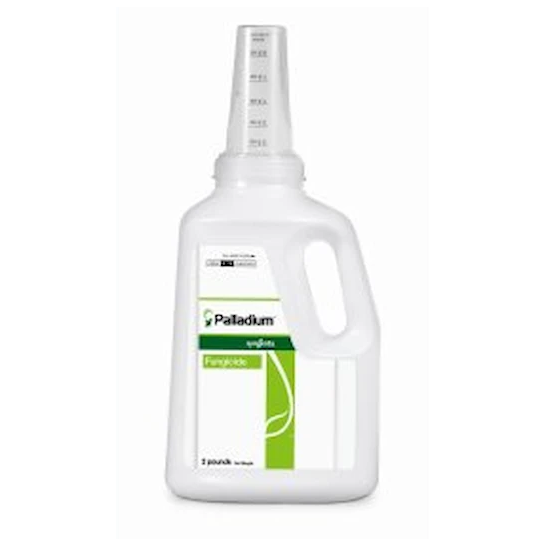
Palladium fungicide is a broad-spectrum systemic and contact fungicide formulated for the preventative and early curative control of key fungal diseases in ornamental and nursery production systems, forestry, and established commercial landscapes. It combines two active ingredients with distinct modes of action to manage resistance.
Chemical Composition and Formulation
The product is a water-dispersible granule (WDG) formulation. The active ingredients are cyprodinil at 37.5% and fludioxonil at 25.0%, for a total active ingredient concentration of 62.5%. This formulation is classified by the Fungicide Resistance Action Committee (FRAC) as a Group 9 (fludioxonil) and Group 12 (cyprodinil) fungicide.
Functional Mechanism and Design
Cyprodinil is a systemic anilinopyrimidine fungicide (Group 12) that inhibits methionine biosynthesis and secretion of fungal enzymes integral to penetration and pathogenesis. Fludioxonil is a contact phenylpyrrole fungicide (Group 9) that disrupts osmotic signal transduction via the fungal MAP/histidine kinase pathway. This dual-mode-of-action combination provides both local systemic and protective activity, enhancing disease control and resistance management.
Target Applications and Performance
Palladium fungicide is labeled for the control of diseases caused by Botrytis species, including gray mold (Botrytis cinerea), and other pathogens such as Alternaria, Anthracnose (caused by Colletotrichum spp.), Corynespora leaf spot, Cylindrocladium, damping-off (Rhizoctonia solani and Fusarium spp.), downy mildew, Fusarium wilt and root rot, Phomopsis, Phytophthora aerial blight, and Rhizoctonia aerial blight and root rot. It is approved for use on ornamental flowers and plants; ornamental bulb, corm, and tuber crops; conifers; and Christmas trees. Approved sites include greenhouses, nurseries (field- and container-grown), shade houses, lath houses, conifer and forest nurseries, forestry plantations, retail nurseries, interiorscapes, commercial landscapes, golf course ornamentals, and landscaped areas around institutional, public, commercial, and industrial buildings, parks, recreational areas, and athletic fields.
Application Specifications and Protocol
Application rates vary by disease, crop, and use site. For most foliar and drench applications in ornamentals, rates range from 2.0 to 4.0 ounces per 100 gallons of water. For preventative control of Botrytis blight in greenhouse ornamentals, the label specifies 2.0 to 4.0 oz/100 gal applied at 7- to 14-day intervals. For Rhizoctonia damping-off control, a soil drench or spray application of 4.0 oz/100 gal is recommended at seeding or transplanting. Applications can be made as a foliar spray, soil drench, bulb dip, or through irrigation systems. The product must be mixed with water and requires the use of a non-ionic surfactant at 0.125% v/v for optimal performance on foliar applications. A re-treatment interval of 7 to 14 days is standard, with a maximum of 16 applications per year. Do not apply more than 64.0 ounces of Palladium per acre per year.
Handling and Safety
This pesticide is classified for restricted use. It bears the signal word "CAUTION" on its label. Applicators must wear long-sleeved shirt and long pants, shoes plus socks, and chemical-resistant gloves during handling and application. For greenhouse use, posted warning signs are required. The product has a 12-hour re-entry interval (REI) for all uses except greenhouse ornamentals, which have a 24-hour REI. Do not apply to areas where runoff may occur to aquatic habitats. The EPA registration number is 100-1328.