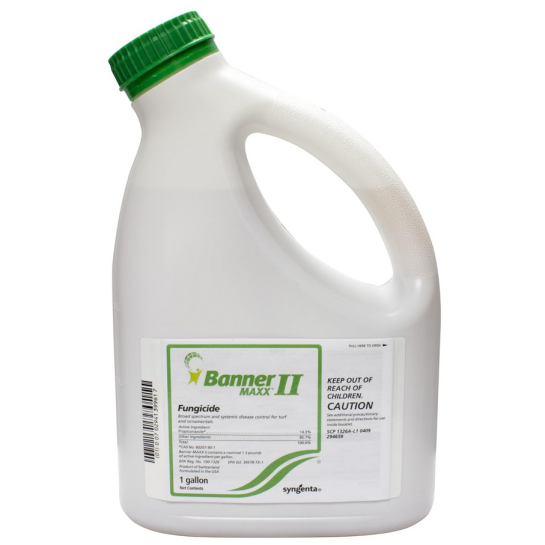
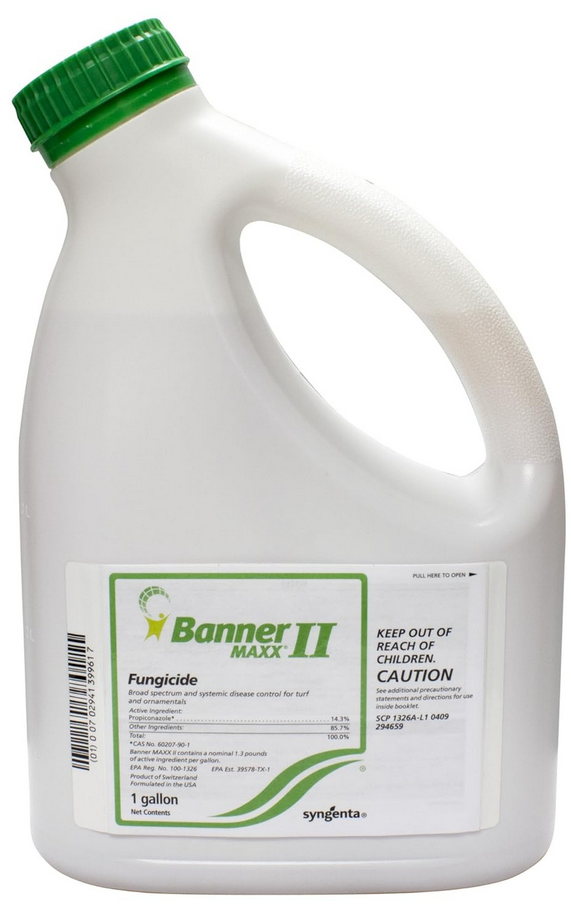
Syngenta Banner Maxx II is a systemic fungicide formulated with the active ingredient propiconazole (14.3%). It is registered under EPA # 100-1326 and carries FRAC Group 3 classification as a demethylation inhibitor (DMI) of sterol biosynthesis. The product has a "Caution" signal word and a Restricted Entry Interval (REI) of 12 hours. It is available in various container sizes including 1-gallon jugs, 10-gallon drums, and a 2 x 1-gallon LinkPak.
Chemical Composition and Formulation
This product contains 14.3% propiconazole as its active ingredient, with a concentration of 162 g/L. It is formulated as a micro-emulsion concentrate (ME) that mixes into a clear solution with odorless properties. The formulation has an amber appearance and provides excellent tank mix compatibility and stability.
Functional Mechanism
Banner Maxx II operates as a systemic fungicide that enters through the plant's surface, stem, or root system and is rapidly absorbed and translocated within plant tissues. It prevents fungal cell growth by inhibiting sterol biosynthesis (demethylation inhibitor), which disrupts membrane synthesis. The product offers both preventive and curative action and is resistant to wash-off after the formula has dried. Rainfastness occurs within 48 hours.
Target Applications and Performance
This product controls more than 20 turf diseases, providing disease suppression for 21 to 28 days depending on label rates and spectrum. For ornamentals, applications are made every 14 to 21 days depending on disease pressure.
Turf diseases controlled include dollar spot (Sclerotinia homoeocarpa), brown patch (Rhizoctonia solani), anthracnose (Colletotrichum graminicola), red thread (Laetisaria fuciformis), pink patch (Limonomyces roseipellis), rust (Puccinia graminis), powdery mildew (Erysiphe graminis), stripe smut, summer patch (Magnaporthe poae), necrotic ring spot (Leptosphaeria korrae), spring dead spot, take-all patch (Gaeumannomyces graminis), leaf spot (Bipolaris spp., Drechslera spp.), gray leaf spot (Pyricularia grisea), pink snow mold (Microdochium nivale), Fusarium patch, gray snow mold (Typhula spp.), yellow patch (Rhizoctonia cerealis), and zoysia patch.
Ornamental diseases controlled include powdery mildews, rusts, leaf spots (Alternaria spp., Cercospora spp.), scabs (Venturia inaequalis), and blights, as well as black spot (Diplocarpon rosae) on roses.
Use sites include athletic fields, golf courses (fairways, tees, roughs), residential and commercial lawns, sod farms, cemeteries, parks, recreational areas, nurseries, greenhouses, trees, shrubs, and ornamentals.
Application Specifications and Protocol
For turfgrass, application rates range from 0.5 to 4 fluid ounces per 1,000 square feet, with application intervals of 14 to 28 days. Do not exceed 4 fluid ounces per 1,000 square feet per application. The maximum annual application rate is 5.4 gallons per acre per calendar year. Generally, one gallon of mixed solution treats approximately 1,000 square feet, requiring 0.5 to 4 ounces of product per gallon of water.
For ornamentals, spray rates range from 2 to 24 fluid ounces per 100 gallons of water, with application intervals of 14 to 21 days.
For brown patch prevention on tall fescue, apply 1 to 2 fluid ounces per 1,000 square feet at 14 to 21 day intervals, beginning in May or June before disease is present. Under conditions of high temperature and humidity, use higher rates and shorter intervals.
Apply when conditions are favorable for disease. Do not apply during the heat of the day in full sunlight, as plants are more stressed and will not absorb the product as readily. Early morning applications are recommended. Do not apply through any type of irrigation system. Do not use a hose-end sprayer, as these do not deliver even application and cannot achieve proper dilution. The product does not require a surfactant or adjuvant. No irrigation or rainfall is recommended within 24 hours following application. The product does not need to be watered in after application.
Use Restrictions and Compatibility
Do not apply more than 16 fluid ounces per 1,000 square feet per year on turf. Do not use in greenhouses. Do not use as a tree injection. Avoid applications to stressed plants or during high temperatures. Not for use on residential fruiting trees, vegetables, or edible crops. Bermudagrass can be sensitive to Banner Maxx II. Do not allow runoff into water sources; the product is toxic to fish and aquatic organisms. Do not apply more than 5.4 gallons per acre per calendar year. The product is not registered for sale or use in all states; check local registration status before purchase.
Handling and Safety
Applicators, mixers, and loaders must wear a long-sleeved shirt, long pants, shoes, socks, and chemical-resistant gloves. Handlers using hand-held equipment must also wear the same PPE. Early-entry workers must wear coveralls, shoes and socks, and chemical-resistant gloves made of any waterproof material. During mixing and loading, additional protection including a nitrile gloves certified to EN 374-3, protective eyewear certified to EN 166, and protective boots certified to EN 13832-3 may be required depending on local regulations. Avoid inhaling spray mist; use in well-ventilated areas. The active ingredient is harmful if swallowed (H302) and toxic to aquatic organisms with long-lasting effects (H411). Contains propiconazole, which may produce an allergic reaction (EUH208).
Storage and Disposal
Store in a cool, dry place away from food and feed. Protect from direct sunlight. Do not store in damp or warm locations. May be frozen. Dispose of containers according to local regulations.