What is Controlled Environment Agriculture (CEA)?

Controlled Environment Agriculture and Related Systems
In the horticulture industry, there are countless variations of production that come in all shapes and sizes. With the research and advancements to our methods of cultivating crops, the facilities we have grown commercially in have become known as a sector of agriculture called Controlled Environment Agriculture (CEA). In these systems, all aspects of the plant’s environment are controlled at optimum settings for maximized yields.
Controlled environment facilities have a strong technology centered approach towards production seeming almost other worldly in their automation and maximization of space. These systems are also known for their ability to maximize resources such as water, light, environmental monitoring, nutrient delivery, and grow media.
CEA’s are highly customizable and can be found all across the globe. Traditionally, a high tunnel or greenhouse is used as a controlled environment, however, there are countless others that are labeled under this category. 
| Facility Type | Description |
| Commercial Greenhouse: Small to Large Scale | A solid structure traditionally used in the cultivation of crops. Structure is fully enclosed with plexiglass, glass, or other forms of plastic. |
| Indoor Farming | A concept of growing in a building not labeled as a traditional grow area. |
| Grow Warehouse | A larger structure that is used to cultivate crops. These can be actual warehouses or large metal structures that house plants for production. |
| Vertical Farms | A trend becoming more common place where plants are produced on multiple levels and grow up instead of out. In urban areas, these are used as living walls and help provide green spaces while also producing foods and crops. |
| Shipping Container Set- Up | A movement of reuse and reduce has seen the installment of shipping containers being used as a plant cultivation structure. Growers will use one or multiple containers connected together to cultivate crops. These are great for use in urban settings with limited space. |
| Multi- Level Set Up | Multi-level set ups allow a grower to plant in more space than a traditional greenhouse as plants can be grown on multi-levels. |
| Attic/ Rooftop Set ups | These structures utilize unused space in a house or building. These can be enclosed at the top of the house or structure. In urban settings this is an ideal set up and can offer more than just a production opportunity. Green spaces in urban areas help with overall employee satisfaction and helps improve air quality in these areas. |
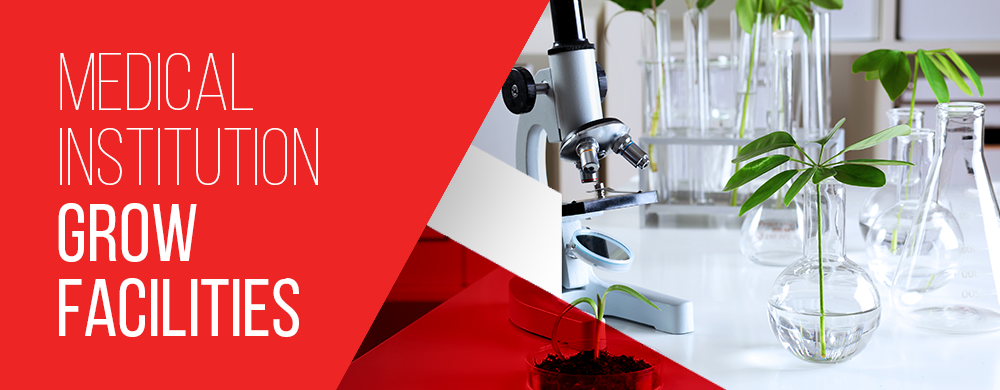
| Medical/ Institution Grow Facilities | With the increased ability of commercial facilities being able to grow large scale hemp for production or research, producers are able to convert grow areas for this crop. |
| Build Outs | By building out from a standard building through either a lean-two or an addition. These typically are smaller than a commercial greenhouse and can be classified as a small to medium greenhouse. |
 Each structure is customizable and is not always the same as another producer’s structure. The above information is simply a general and loose definition of these structures. Within these structures, there is still the use of specific technology, automation, and management practices that take conservation to a whole new level in comparison to traditional methods. These systems are able to, in most cases, automatically conserve water and energy, meaning less strain on the budget and more green conscientious.
Automation and Technology In today’s commercial crop production, technology plays an important role in ensuring increased production and yields. Without automation, a commercial producer can not grow to their full potential. Automation has made it possible for a greenhouse to produce more than traditional methods.
In order to take advantage of these increased yields, a production manager can adopt simple or more advanced techniques according to preference or the budget. Common automation practices are automatic watering and auto fogging systems, environmental control systems, nutrient delivery, drip irrigation control, and climate control systems. While others are fully automated with moving planters, transplanters, plant moving robots, rotating shelving, etc. The use of this technology has many benefits. Studies have shown that the installation of automation reduces overall costs and losses while also increasing worker efficiency.
A commercial greenhouse or nursery can easily switch aspects of their facility to transition to a ‘smart’ greenhouse. The installation of timers and sensors in a grow area can control virtually every aspect of the grow area from lights, water, temperature, and nutrients. Through the use of Wi-Fi, a grower can control aspects of their greenhouses through a mobile app without even stepping foot in the area. Thermostats in today’s technology forward industry have the ability to monitor more than temperature. With sensors for temperature, humidity, fresh air levels, and air cleanliness, a producer can monitor and control the grow environment.
Additional sensors can be installed for the monitoring of carbon dioxide levels, as well as controlling them for optimum levels customized to the crop’s needs. Timers can be used to water crops with ease by turning on the pumps and irrigation systems. Technology and automation are the future for the horticulture industry and are essential to keep up with increased demands and yields. Within smaller spaces, such as those used in urban agriculture, the use of these technological advancements enable these businesses to produce more efficiently per area in comparison to larger scale operations. Conservation
Growing in smaller confined spaces allows for a facility to conserve not only in labor, but also in the use of materials. These systems have been shown to reduce water consumption and have lower energy costs. With the use of timers and sensors, the systems do not turn on to water until the soil reads at a set percentage. The system will then turn on to water the crops for a specific amount of time.
By doing this, the producer can reduce the overall water used and increase the efficiency of the overall system. In traditional hydroponics, greenhouses with these systems use around ten percent less than in the field. This is in part because the unused water not absorbed by the roots of the crop gets recirculated and reused. In systems that are confined to smaller spaces, hydroponics can be used to water crops to increase efficiency and make it easy to water plants especially if the system is on multiple levels and includes harder to reach places.
Getting Started with Set-up for an Automated, Technology Based Grow Area
Regardless of the type of structure used for the grow area in a commercial setup, it is important to get the right tools and supplies to get the job done right the first time. Wholesale companies knowledgeable about their products are the best source for these materials for the commercial producer.
After looking at individual goals for the growing season, the grower should develop a checklist for the material needed. For simple automation for watering, for example, a grower would need to purchase timers, water pumps, and irrigation piping (typically PVC) and related materials for construction (glue, cleaner, and cutting tools) to install the system.
For conservation of energy consumption, the use of timers for lights and the conversion to LED bulbs will help with the overall reduction of costs.
About MORR Inc.  MORR Inc. is a wholesale commercial agriculture distributor for planting, growing, and farming located in Los Angeles, CA. MORR Inc. supplies top of the line wholesale commercial hydroponic systems, commercial grow systems, a wide selection of grow lights and automated control systems, nutrient rich soils and growing media, a large selection of specialized advanced plant nutrients for different plant life cycles, dosing and drip irrigation systems, high tech environmental meters and automated systems, fans, filters, plant pesticides, plant fungicides, general commercial grow facility supplies and services, plus much more! Visit us at https://morr.com

About
MORR Inc.
MORR Inc. is a wholesale commercial agriculture distributor for planting, growing, and farming located in Los Angeles, CA. MORR Inc. supplies top of the line wholesale commercial hydroponic systems, commercial grow systems, a wide selection of grow lights and automated control systems, nutrient rich soils and growing media, a large selection of specialized advanced plant nutrients for different plant life cycles, dosing and drip irrigation systems, high tech environmental meters and automated systems, fans, filters, plant pesticides, plant fungicides, automated crop management systems, general commercial grow facility supplies and services, plus much more!
Call- 1-310-967-2022