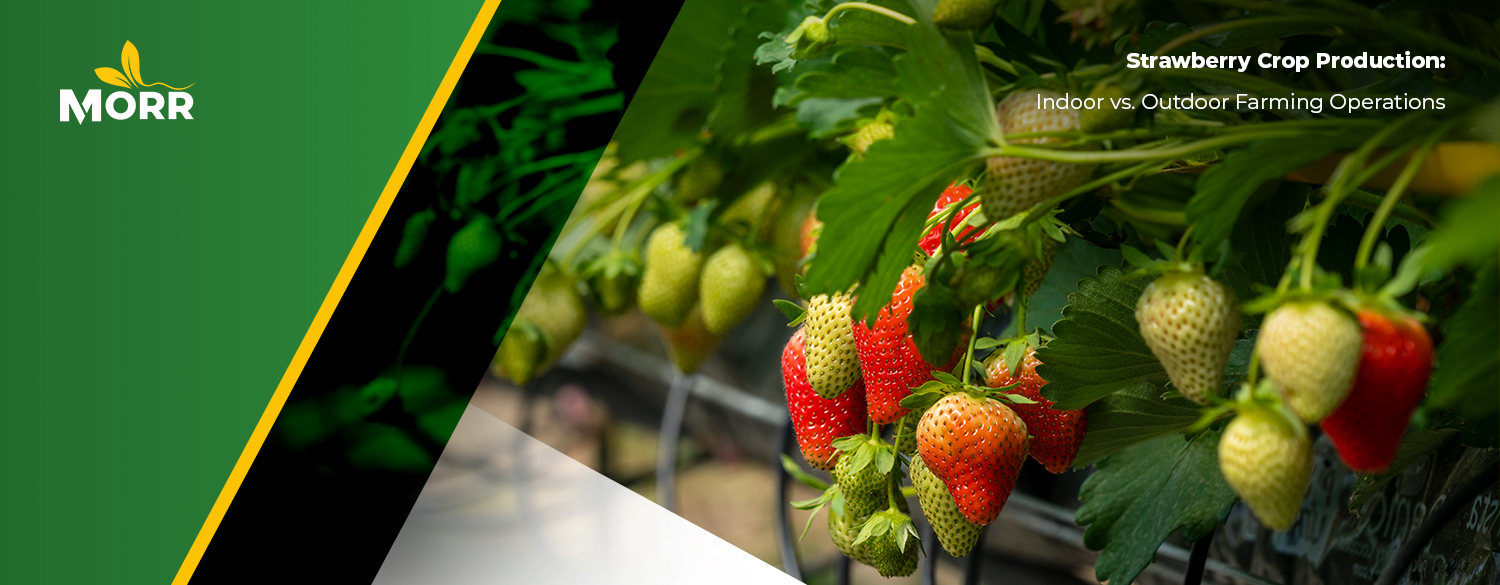
Strawberry Crop Production: Indoor vs. Outdoor Farming Operations
Commercial Strawberry Crop Production
Strawberry plants can be a great income-producing alternative to a traditional set-up with different crops. On many summer days, a drive can show many pick-your- own operations, and farmer’s markets. However, strawberries can also be a great cash crop for a commercial operation. Before deciding to grow strawberries, it is important to consider all the aspects of their growth and whether or not the strawberries are to be grown indoors or outdoors.
Basic Considerations for Strawberry Cultivation
Among many subdivisions of information for strawberry production, there are four main areas that need to be considered before starting the venture. The first is the overall traits of strawberries. These traits such as their need to be spaced at least a foot to a foot and a half, running tendencies with daughter plants, as well as the need for pollinators. On a commercial scale, there needs to be a replacement schedule in place for plants. There should also be considerations for the environmental needs of the strawberry plants, as well as selecting region specific varieties so that they grow to their full potential. These specific cultivars may also need certain harvesting needs and differing seasonal growth patterns.
Regardless of the choices above, the biggest decision is whether or not to cultivate and grow indoor or outdoors. Both cultivation practices are doable on a commercial scale, however, which is right for an operation is based on facility design, space, and more.
Outdoor Cultivation of Strawberries
Traditionally, strawberries have been grown outdoors in fields. In fields strawberries require full sun, have a gradual slope, and in soil that is well draining packed full of organic material. The best field soil for strawberries is a deep, sandy loam where the field does not keep wet into late spring.
In August, most commercial producers will start to prep fields for the new plantings of strawberries. Strawberries naturally grow as perennials, but in the commercial realm many treat them as annuals. In field prep includes the removal of old plants and all plant material from the previous season, applying fertilizers, and plowing the field. After this is completed, growers need to mound the soil into plateaus and a plastic laid down to prevent the growth of weeds. Drip lines are also suggested to be installed alongside the plastic install as strawberries grow best with irrigation done at the ground level and not over foliage.
When ready, strawberry plants will need to be planted by hand as they are very delicate. Depending on the operation, a grower can plant between 15,000 - 20,000 plants per acre! During the colder months the strawberries will need to be covered in freezing temperatures and have a regimen of water and fertilizers. Once warmer days come, the strawberries will take off and begin to grow through vegetative growth and then will bloom. These flowers will need pollination. Some growers will release pollinating insects in their fields to promote proper pollination. Once pollinated, fruit growth can begin.
For the harvest, it should be noted that strawberries will grow and ripen very quickly and will need daily picking. Due to the delicate nature of plants, they will need to be harvested by hand. The number of needed harvesters differs from operation to operation. On average, it is estimated that it will take 65-70 workers per 1,000,000 plants picked.
Outdoor cultivation is best suited for the operation that has the space and the right soil composition. It is very important to be in the right climate and to apply fertilizers as needed. As this is the traditional way of cultivation, it is very ideal. However, indoor cultivation has become more popular in recent years. What exactly makes it so popular?
Indoor Cultivation of Strawberries
In recent years, the cultivation of crops has moved indoors and places that are different from the traditional fields. Strawberries can be grown indoors in greenhouses , high tunnels, and even in warehouses. There are several options for indoor cultivation that depend on space, design, and overall type of operation.
Some operations grow their strawberries directly in the soil, but protected with a high tunnel or structure. Others have taken a more condensed approach and have integrated hydroponic technology to grow strawberries vertically. The requirements are the same for strawberries indoors as outdoors with lighting, fertilizers, and harvesting. However, the application of fertilizers is done with liquid fertilizers that can be added to the water system. Lighting is also supplemented with LED’s or other bulb lighting. Caution should be taken in ensuring enough spacing between plants and temperatures are maintained to replicate outdoor growth well.
For more information on how to integrate hydroponics and LED grow lighting into your growing operation, as well as information on strawberry cultivation be sure to reach out to MORR consultants and ask about our commercial grow build out services today! Call: 1-855-TRY-MORR

About
MORR Inc.
MORR Inc. is a wholesale commercial agriculture distributor for planting, growing, and farming located in Los Angeles, CA. MORR Inc. supplies top of the line wholesale commercial hydroponic systems, commercial grow systems, a wide selection of grow lights and automated control systems, nutrient rich soils and growing media, a large selection of specialized advanced plant nutrients for different plant life cycles, dosing and drip irrigation systems, high tech environmental meters and automated systems, fans, filters, plant pesticides, plant fungicides, automated crop management systems, general commercial grow facility supplies and services, plus much more!
Call- 1-310-967-2022