How To Decide Which Brand of Stonewool is Right for You
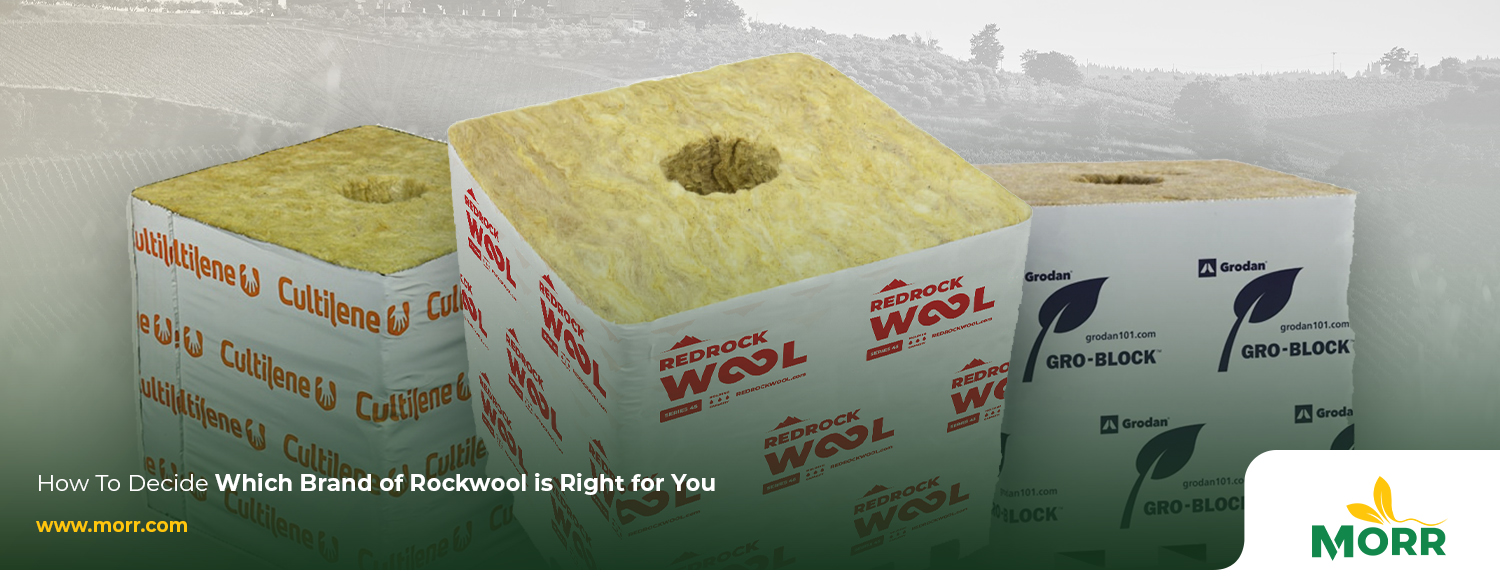
Insight into the variables setting RedRock, Grodan, and Cultilene apart from the prospective of a distributor.
We would like to share the differences, strengths, weaknesses, and underlying capacities of the respective rockwool companies vying for space on your farm. Our goal is to assist consumers in making better decisions by sharing insights gleaned from walking thousands of farms and having distributed Cultilene, Grodan, and RedRock as well as spoken with company executives and employees at all three companies.
Rockwool manufacturing can only be accomplished by a few companies globally. The reason for this is that in order to manufacture stonewool, it’s necessary to have the following:
- A raw material source
- An expensive manufacturing plant to produce the raw rockwool board (Unprocessed material)
- An expensive production facility to take that board and make it into blocks, slabs, and plugs (Processed material)
- A distribution arm consisting of warehousing, logistics, and sales, to get product to the consumer
Let’s start by focusing on the manufacturing of the raw rockwool board and what variables are relevant. In our opinion the raw material provider is relatively unimportant. All the major players in the space (Cultilene aka CultiWool, Grodan, and RedRock) utilize quality raw materials and standard operating procedures that are not very different from one another.
The variables that mater when analyzing the raw material are primarily density and consistency.
THE DENSITY STORY
Density is essentially how much rock was put into a block, slab, or plug. The higher the density the more rock that was melted, spun into wool, and processed into the product. It’s important to keep your eye on this metric to ensure you are getting what you paid for. Just like a company could cut costs by putting less cookies in the box, so too, rockwool companies can adjust density to save on costs. A prime example of this is the Grodan Improved verse the Grodan Pargro lines verse the Grodan PlantTop, etc.
Density is also important because it is one of the major variables associated with water holding capacity and drainage rates. More rock means more surface area for better holding of water and fertilizers. As density decreases products have higher air porosity and will generally have higher water mobility and drainage. There is a sweet spot where the product holds onto water and fertilizers just long enough to maximize their availability to the plant and still allow for crop steering. If the density is too low, you’re flushing your two precious resources, water, and nutrients, down the drain before the plant was able to access them.
Increasing density will result in a higher field capacity which allows for a greater differential between complete saturation and the most extreme dry-back. A product with the ability to hold more water for a longer duration of time will allow growers to achieve wider ranges and better crop steering. Additionally, being able to reduce overall irrigation volume offers significant savings.
Our belief is that changes in product density can be overcome by changes in irrigation strategy. A more porous media will require more frequent irrigation. This could be a benefit or a detriment depending on other variables such as environmental conditions, indoor verses greenhouse, and LED verses HPS.
From our tests it seems Cultilene and Grodan Pargro have the lowest density, Grodan PlantTop and Improved are somewhere in the middle, and RedRock would have the highest density. For each inch of product there is more rock in RedRock blocks, slabs, and plugs then with other products and brands. If you would like to see for yourself simply place the products on a scale and adjust for volume to see which product is the inch for inch rockwool king. It is important to remember that the sticker price of the product is only half of the story. If we sell you a product that cost less and cuts nutrient and water consumption then we are offering something materially different. That is attainable with RedRock.
THE CONSISTENCY AND UNIFORMITY STORY
It’s true that the more consistency across your crop, your growing area, and your environment, the more consistency you’ll find in yield and quality. That said, there is necessary consistency and uniformity and then there is marketing and fictional consistency and uniformity.
The three brands mentioned in this article are all offering consistency required for commercial crop producers to perform at the highest level. Don’t believe that one is superior to the other. Certainly, there are lower quality brands and products in the market that do affect uniformity and one’s ability to anticipate water mobility but among the brands controlling the majority of the market share (Those mentioned above) we have not seen that one is more reliable than the other.
What’s most important to remember is that ROCK WOOL IS A COMMODITY AND THE GOAL OF A COMPANY SELLING COMMODITIES IS TO TAKE A LOW-COST AND READILY AVAILABLE PRODUCT AND SELL IT FOR THE LARGEST PROFIT POSSIBLE.
How does one do this? By convincing the consumer that their product is somehow “Superior”, “Improved”, or “Data driven”. If you are growing for profit, it’s crucial to cut costs and watch expenses. Don’t make your purchasing decision based on faulty premises, rather, run the numbers, run the trials, and select the product that generates the best results and return on investment. We have sold all the brands, ran countless trials, and taken customer feedback and from our data sets it is clear RedRock is a win.
We have found Cultilene offers a low-cost product that wastes water and nutrients. Grodan offers a high-cost product that does a good job of trying to maximize plant growth and water and nutrient availability. RedRock offers the best value product since it’s the most competitively priced and maximizes resource utility for less overall water and nutrient waste. In order of cost effectiveness from most competitive to least competitive is (1)RedRock, (2)Cultilene, and (3)Grodan.
A FEW DIFFERENCES
Grodan and RedRock have manufacturing and processing in North America, Cultilene does not. All three have US distribution yet the distribution channels look very different.
Cultilene is the most limited to the point that the product is rarely found. Depending on international shipping, lead times and availability can vary greatly and at times the product cannot be purchased due to lack of supply in North America. This forces farms and growers to switch to another supplier or face significant delays in planting. Lead times from shortest to longest are (1)RedRock (Approx. 2 weeks), (2)Grodan (Approx. 5 weeks), and (3)Cultilene (Approx. 8-12 weeks). Containers shipped from overseas can only hold around 20 pallets of product so there is more freight over a smaller amount of cargo. By contrast RedRock and Grodan ship truckload quantities of 30 pallets at a time.
Grodan is available everywhere. They sell through a few master distributors, to wholesalers, to the consumer. This means there are more hands touching the product before it gets to you and therefore an elevated price for what the other companies are offering for less. By attending all the tradeshows, employing many product reps, and attempting to produce “Data driven marketing”, Grodan further elevates their prices to the consumer.
Cultilene has little to no presence in North America. Even if you find their product there are no reps, low inventory levels, and little support.
RedRock intentionally limits distribution to only what is needed to cover the US. For less than container volumes there are vendors spread out across the map with mostly non-overlapping territories. This ensures coverage and fair pricing for all. Full containers ship direct from their plant.
THE PROS & CONS OF THE BIG THREE
Grodan Grow Blocks
- Large capacity
- Lots of staff
- Attends tradeshows
- Lots of marketing
- Widely available
- Consistent quality
- Expensive
- Medium density
Cultilene
- Small presence in North America since the product comes from overseas
- Long lead times and availability issues
- Few staff
- Lacking technical support
- Does not attend tradeshows
- Little marketing
- Consistent quality
- Low cost
- Low density
RedRock Grow Blocks
- Large capacity
- Strategically minimizes staff
- Strategically does not attend tradeshows
- Strategically minimizes product marketing
- Available through restricted distribution channels, not everywhere to everyone
- Consistent quality
- Low cost
- High density
In summary, it is worth while testing any reliable brand of rockwool. When doing so be sure to check the sale price, check nutrient and water consumption, and evaluate your overall return on investment (ROI). Stonewool should not be an overstudied science but rather a means to a highly productive end goal of producing more yield and better quality. That can be achieved in any of the afore mentioned brands with an adaptive irrigation strategy.
Click here to shop our entire selection of commercial-grade stonewool grow media

About
MORR Inc.
MORR Inc. is a wholesale commercial agriculture distributor for planting, growing, and farming located in Los Angeles, CA. MORR Inc. supplies top of the line wholesale commercial hydroponic systems, commercial grow systems, a wide selection of grow lights and automated control systems, nutrient rich soils and growing media, a large selection of specialized advanced plant nutrients for different plant life cycles, dosing and drip irrigation systems, high tech environmental meters and automated systems, fans, filters, plant pesticides, plant fungicides, automated crop management systems, general commercial grow facility supplies and services, plus much more!
Call- 1-310-967-2022