Commercial Hemp Farming Guide
Growing Commercial Hemp: The Buyer’s Guide to Needed Materials, Equipment, Grow Systems
In the commercial production of hemp, growers need to be sure that the set-up, equipment, and environment is suitable for their crops for the ultimate yield. Anything that plants lack even for a short amount of time will overall affect the growth and production of the plant. Temperature, water, plant nutrients, and grow lighting must be held at adequate amounts to promote the best growth. When the commercial nursery or greenhouse makes the switch to commercial hemp production, the process may seem daunting. Hemp production is similar to many other industry crops, so the switch can be quite easy.
Getting Started: When planning out a greenhouse, nursery, or farm for hemp it is important to always plan for expansion from the start. If the grower is already producing crops of different varieties in the greenhouse, sometimes all focus goes to production and not the new avenues opened by hemp production. It is important for a producer to plan for future demand, within reason, and to accommodate long term goals for the business. It is better to have more than needed space than not enough in the long run.
The plans should encompass a multi-level approach for expansion and thinking ahead to the future. Overall the greenhouse should have multiple areas set aside specifically for stages of the hemp production process. These rooms serve the purpose needed in the different stages of hemp production. For example, a basic setup for a commercial hemp production facility is outlined below.
| Room | Purpose |
| Mother Room/ Cloning | This room houses the original plants used for the large scale production of hemp. These plants are used for cuttings and “clones” to produce multiple plants from a single “mother” plant. |
| Grow Room | This room can be a single room or multiple with the specific purpose of cultivating and growing the crop. |
| Flowering Room | Depending on the purpose of your hemp production business, you may not have a flowering room, however this room is used for plants that are at the flower stage for bud production. |
| Drying and Curing Room | After harvesting the hemp, the resulting yields must be cured and dried. Setting an area aside for this practice will ensure proper drying and cure. |
| Trim and Packaging | Similar to the floral industry, hemp needs trimmed and touched up before packaging to remove damaged leaves and plant tissue. After the trim, the plants can be packaged. |
| Shipping and Processing | Having a place specifically set aside for shipping the product is ideal as it separates the finished product from other. This also help with security and clearance for the shipment process, as the product will already be packaged and secured. |
| Customer and Employee Rooms | These are basic areas for all employees and if applicable, customer relations. |
Having these areas separated and labeled, will help with the growing process and organization of the commercial producer’s endeavors. A greenhouse producer should balance the production efficiencies within their grow area. Modern technology and structures offer unbelievable production opportunities in comparison to traditional techniques of hemp growing. In the grow area, zone segmentation should be achieved to divide sections for specific needs. In these zones, proper heating and cooling systems need to be in place, as well as lighting and irrigation.
Traditional VS Hydroponic Hemp Production  When a commercial producer makes the decision to either start a new operation or convert their operation to hemp production, there are two main options for the setup. The top two methods for hemp production are traditional / conventional and hydroponic systems. Although the choice of the system is up to grower preference, these systems each have positives and a few drawbacks that set them apart from each other. When looking at a traditional system, the grower is planting the plants in soil, whether directly in the ground, or in pots. When working with soil, it is important to note that hemp contrary to common belief is relatively particular of the soil it grows in. Hemp grows best in a soil that is well aerated meaning loose and containing high levels of oxygen.
The soil should be rich in nutrients and have a pH in the range of 6.0-7.5. If the hemp is planted in a soil that is not ideal, such as a poor draining soil like clay, the hemp plants will commonly have establishment failures due to damping-off. A sandy soil can be used, however, this requires extensive irrigation and nutrition amendments that growers will find it uneconomical. In soil production of hemp, a grower has the choice to grow directly in the ground like a traditional field crop or in pots housed within a greenhouse.
Plants grown directly in the ground can be housed in a high-tunnel for added protection like that of a greenhouse. In a greenhouse, the producer will need to implement a potting system with irrigation and temperature controls. The benefit of growing indoors within a greenhouse structure is the ability of the grower to control every aspect of the plant’s environment and growth. In order to control these environments in a greenhouse, the structure will need irrigation, lighting, temperature controls, and nutrients. Watering should be done from the bottom of the plants instead of overhead to reduce water loss and the possibility of mildew growth on the plants.
A drip irrigation system or an ebb and flow table is ideal. However, the use of misters can be implemented to increase the humidity in the grow area. Hemp plants can be started in smaller pots and transplanted to larger ones to accommodate the growth of the plants through the lifecycle. This will also conserve space in a greenhouse during crucial starts to growth seasons when space can be limited due to germinating plants. Typically the mature plants will need to be in a 5-gallon pot for ideal root growth and space for top production. A good rule of thumb is the smaller the container, the smaller the plant. In hydroponic production, the hemp plants are grown very similarly to tomato plants as these crops are of the larger plant category. Instead of growing in soil, these systems use soilless media to grow plants.
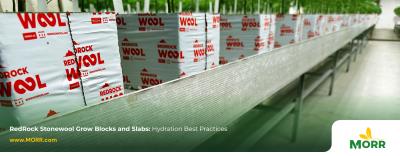
To fully utilize the space within a greenhouse, the option of going vertical is ideal. Going vertical, allows the facility to maximize space. In order to implement a hydroponics system, the grower will need rockwool or other soilless media to grow in. stonewool is ideal and allows for easy transplanting into larger grow blocks. The rockwool can also be customized to the exact needed shape and size. After planting the help into rockwool slabs or cubes, the system should have an irrigation system installed.
The same approach can be used for the hydroponic system as the traditional through using drip or ebb and flow systems. The specific system needed for hemp production is mainly up to the producer and their exact needs. Read more about growing hydroponic hemp here- https://www.morr.com/news/hydroponic-growing-of-hemp/
| Materials Needed For a Hydroponics System | |
|
Looking at the Methods Up Close
| Traditional | Hydroponic |
|
|
Lighting Requirements In a New Hydroponic Hemp Production Set-Up Lighting is crucial for the production of plants in a greenhouse. If light is not controlled to the ideal length and intensity, the plants will not grow to their full potential. In hemp production, one of three artificial sources of light can be used. These are HID, CFL, and LED. High-intensity discharge lights (HID) have been used in hemp production since the early 1990’s. Since the 90’s these lights have gone digital and more efficient.
A grower that favors the HID focuses on the lumens for plant growth and hold it to high importance. CFL bulbs are becoming less used in the industry due to vast improvements within the LED light technology. The light-emitting diode (LED’s) are beginning to take over the greenhouse industry and soon may out sell and perform the HID lights. The newer systems of LED bulbs have been shown to produce hemp of high quality more so than the average HID system. LED lights have become more energy conscious and use less energy and give off less heat without sacrificing the light quality.
For maximum yields, a commercial grower should aim for 1000W+. The lights being used should be installed so that the distance can be changed between the light and plant to accommodate for the plants life cycle changes. Typically, lights should be placed roughly 30-50 cm for HID lights, 10-50 cm for CFL lights, and 15-50 CM for LED grow lights. Be sure to check your hemp plant variety’s needs before installing lights to get the correct spacing.
Hemp Plant Nutrient Needs:
With the increase in hemp production commercially in the United States, research has been conducted through top universities to ensure that yields can be maximized. An industry myth is that hemp production doesn’t need additional nutrients added to the plants environment. This is far from the truth. For maximized yields, a grower should monitor all nutrients and apply amendments when needed. Traditionally, hemp plants will require added nitrogen, phosphorus, calcium, and sulfur. As a reference point, the production of hemp is similar to that of high yielding wheat or corn.
| Nutrient | Suggested Amounts** |
| Nitrogen | 100-130 lbs/ acre |
| Phosphorous | 45-70 lbs/ acre |
| Potassium | >250ppm in the soil |
| Sulfur | >5000ppm in the soil |
| Calium | <6000ppm in the soil |
| Organic Matter | >3.5% |
** Not every crop will require the same. Close monitoring of the soil or water solution is ideal. Always apply based on the crops individual needs. Figures above are average ranges. Find out more about plant nutrients here- https://www.morr.com/news/want-healthy-crops-the-key-is-in-the-nutrients/
Hemp Growing Temperature Requirements:
Temperature plays a key role in the production of plants in any situation and in any crop. If temperatures are too cold, the plants will be stunted. If they are too hot the plants will not grow or will burn. Hemp is no different and requires specific temperature ranges that will maximize yields for commercial production. On average, hemp plants require temperatures in the range of 66-77 degrees fahrenheit.
Temperatures below this will cause the growth to be slowed or stop altogether depending on the plant’s stage of growth. Temperatures well above this range will cause stress to the plant and will impact the growth. In the commercial industry, growers turn towards automation in order to maintain their temperatures. The use of digital systems is ideal and allows the growing environment to run on its own allow the grower to focus on other matters.
By setting a temperature, the greenhouse will operate autonomously through fans, ventilation, humidity, and irrigation controls. It is important to remember, that not every setup design is ideal for every grower. The setup should be customized to the individual grower’s needs and built around their wants, goals, and needs.
By ensuring the set up is the right match, a grower can have less stress and overall work in maintaining the system. Furthermore, the implementation of automation can solve many headaches that come with regulating systems, Using manual techniques can be even more stressful when growing a new crop. When making the decision to start into the commercial hemp industry, remember to customize it to your needs and that it is not a one size fits all.
Hemp Farming Irrigation, Hemp Fertigation, and Hemp Farm Automation Automation in a commercial operation is an ace up a grower’s sleeve, as it aids in making manual tasks easier and less of a burden on an operation. Any degree of automation can help reduce costs, increase efficiency, and create a safer and more positive workplace for workers in a commercial greenhouse. The use of an automatic watering system in commercial hemp production is ideal for a crop that grows healthy and meets the goals of the grower in yield size. These automatic watering systems are able to be set on a timer and pressure setting to meet the individual needs of a specific crop.
Hemp requires varying levels of water throughout the growth cycle. It is because of this that an automatic watering system aids in smoother transitions between stages of growth. Water stress can lead to slowed growth rates and in some cases tissue and plant loss. For commercial hemp production, a grower should install drip irrigation for their crops.
The use of drip irrigation has been shown to decrease water loss and a lowered risk of foliar fungi and diseases. Drip irrigation has the ability to directly apply the water to the root zone. Instead of applying the water overhead like traditional systems, the drip line applies small doses of water directly to the soil in the root zone. By applying to the root zone, the risk of water runoff is also reduced. Nutritional amendments can be applied to the drip line in liquid form to aid in proper nutrition management in the hemp crop.
Fertilizers and key ingredients can be applied directly to the root zone for optimum absorption. As each commercial operation is different, it is important to remember that there is no cut and dry template for automation. A grower should choose the equipment and level of automation that best suits their goals as a commercial operation. Make sure to check out MORR Inc.’s selection of completely automated commercial crop management and production systems, automated drip irrigation systems, automated dosing systems for fertigation and nutrigation here- https://morr.com/watering-irrigation/fertilizer-dosers-injectors.html
About MORR Inc.-
 MORR Inc. is a wholesale commercial agriculture distributor for planting, growing, and farming located in Los Angeles, CA. MORR Inc. supplies top of the line wholesale commercial hydroponic systems, commercial grow systems, a wide selection of grow lights and automated control systems, nutrient rich soils and growing media, a large selection of specialized advanced plant nutrients for different plant life cycles, dosing and drip irrigation systems, high tech environmental meters and automated systems, fans, filters, plant pesticides, plant fungicides, general commercial grow facility supplies and services, plus much more! https://morr.com

About
MORR Inc.
MORR Inc. is a wholesale commercial agriculture distributor for planting, growing, and farming located in Los Angeles, CA. MORR Inc. supplies top of the line wholesale commercial hydroponic systems, commercial grow systems, a wide selection of grow lights and automated control systems, nutrient rich soils and growing media, a large selection of specialized advanced plant nutrients for different plant life cycles, dosing and drip irrigation systems, high tech environmental meters and automated systems, fans, filters, plant pesticides, plant fungicides, automated crop management systems, general commercial grow facility supplies and services, plus much more!
Call- 1-310-967-2022