Commercial Crop Production and Farming Using High Quality Boron Vs. Unrefined Boron
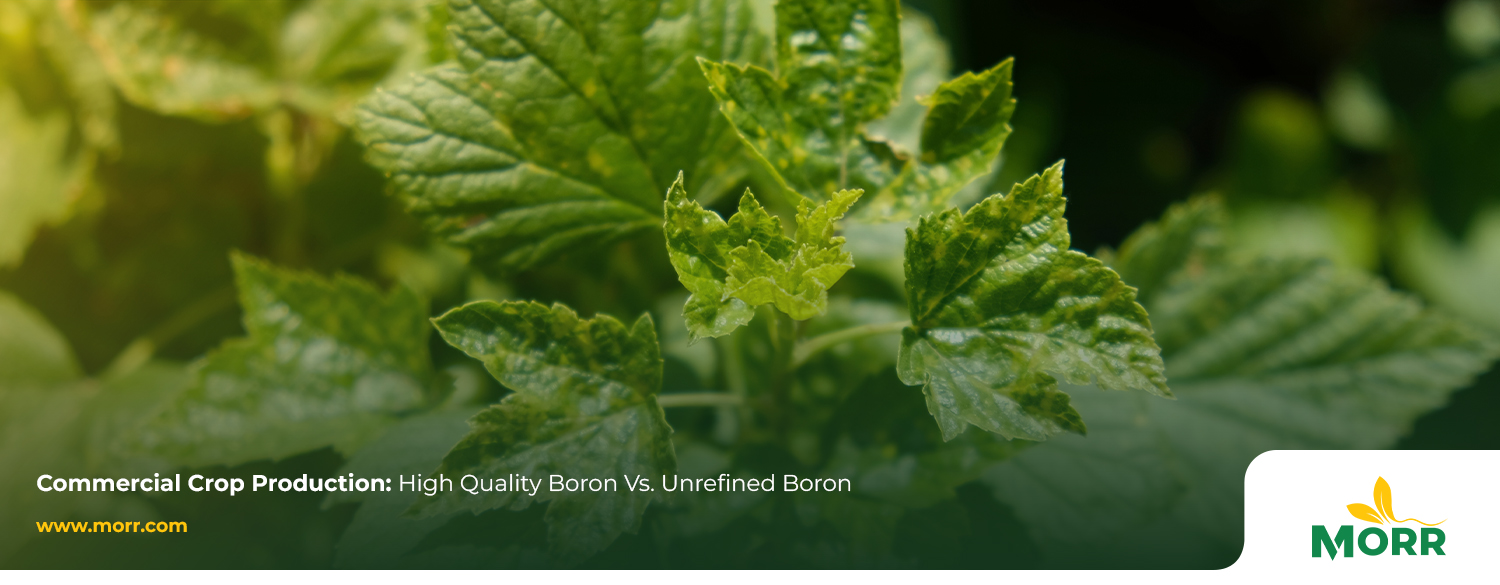
Unlocking the Potential of Boron in Farming- Differences Between High Quality and Unrefined Boron
 There are twenty-one different nutrients and minerals needed by a plant throughout its lifetime. These nutrients and minerals are needed in differing amounts; however, each plays a key role in the growth and development of the plant throughout the growing season. These can come in two forms- macro and micronutrients. Macronutrients are needed in substantial amounts and micronutrients are needed in small doses. Regardless of the nutrient/mineral type, a grower must ensure that those applied throughout the growing season are of the best quality. This ensures proper plant growth, and in some cases, worker safety as well.
Boron is one of the many nutrients needed by a plant. This element plays a vital role in plant functions ranging from cell wall formation and stability, movement of sugars into new parts of the plant, maintenance of structural components, functional upkeep of biological membranes, and pollination and seed set. Boron is regarded as a micro-nutrient, but it plays a key role in plant development.
Boron is applied to fields, pots, and systems through a broadcast method. Growers will also typically apply boron to substrate and soils before planting after extensive soil testing. Boron can also be applied as a seed treatment or foliar spray. This micronutrient can be beneficial to plants and can be harmful like a double-edged sword. A grower should be aware of the specific needs of the plants and the levels already in the substrate before applying boron as there is a fine line between beneficial and toxic. Not only should the levels in the soil be monitored, but also the boron fertilizers themselves should be regulated. A grower needs to know the boron fertilizer quality to make informed choices. Boron comes in two choices- unrefined and refined, but which is best?
Unrefined Boron
Unrefined boron is a fertilizer typically made of crude ore that is washed, dried, and then granulated. These unrefined boron fertilizers have an elevated risk of impurities and heavy metals such as arsenic that can be toxic to plants, workers, and the environment. Unrefined boron also tends to have an incomplete water solubility, meaning it will not break down and move with water. This leads to concentrated areas of high boron and more money spent on fertilizers. Unrefined boron also has a risk of not blending with NPK fertilizers due to irregular granulometry and high hygroscopicity. In addition, these fertilizers have an inconsistent release of boron and a high dust concentration that can lead to uneven application. Unrefined boron also has limited field studies and certifications. However, unrefined boron products are lower in cost when compared to other boron fertilizers.
Refined or High-Quality Boron
Refined boron is also known as a high-quality boron(Such as Granubor Boron or Biomin Boron when related to fertilizers. These fertilizers go through an extensive process to prepare and create a high-quality fertilizer that is ready for crop applications. In the process of refining boron, the first step is to crush and grind down the ore into a fine powder. The powder is then mixed with water and sent through screens where impurities like rocks, sands and other solids are removed. Then the solution is heated until it all liquifies. Cooling the solution will then result in a white solid called boric acid. The product then undergoes other processes that make it safe for applications and other uses outside the horticulture world.
Due to the extensive processing of the boron in the refined fertilizers, there are minimal impurities, dust, fillers, coatings, or added ingredients. These are 100 percent water soluble meaning it will all go to the plants and can be blended well with NPK fertilizers. The fertilizers with refined boron can slowly release the boron in safe amounts without sacrificing quality. The process of heating and then cooling allows for a high granule hardness that prevents the formation of powder during handling, application, and transport.
Granubor Refined Boron
When it comes to refined boron, Granubor is one of the top manufacturers of quality and dependable boron products. Through the process of manufacture, Granubor has mastered the science of creating high quality boron products. Through testing, the products have minimal impurities, dust, fillers, coatings, and added ingredients. Did you know that some boron products have harmful additives like arsenic? Many top brands have reported arsenic levels between 962- 4214ppm! Granubor has a reported level of less than 5 ppm. Granubor boron products are fully water soluble and make them ideal for blending with other fertilizers. The particles have a small particle size (2.8mm) and have an exceptionally low hygroscopicity. This ensures that the boron goes to the whole crop with a gradual and consistent release. Even more beneficial is the overall handler’s safety with Granubor products. The high granular hardness of the boron prevents the formation of powder during handling and application. Overall Granubor, backed by science and research, has developed a high-quality boron that can be applied safely and effectively to crops.
There are many advantages of using a high-quality boron fertilizer, however, the choice to use it instead of unrefined is solely up to the grower and their individual needs. Considerations should be made for crop needs, budget, and goals. For more information about Granubor or other boron needs, be sure to reach out to a knowledgeable staff member at Morr today!
Click here to find out more information about Granubor Agricultural Boron Solutions

About
MORR Inc.
MORR Inc. is a wholesale commercial agriculture distributor for planting, growing, and farming located in Los Angeles, CA. MORR Inc. supplies top of the line wholesale commercial hydroponic systems, commercial grow systems, a wide selection of grow lights and automated control systems, nutrient rich soils and growing media, a large selection of specialized advanced plant nutrients for different plant life cycles, dosing and drip irrigation systems, high tech environmental meters and automated systems, fans, filters, plant pesticides, plant fungicides, automated crop management systems, general commercial grow facility supplies and services, plus much more!
Call- 1-310-967-2022