Acid & Alkaline – Basic Information for The Safe Handling & Storage of Chemicals
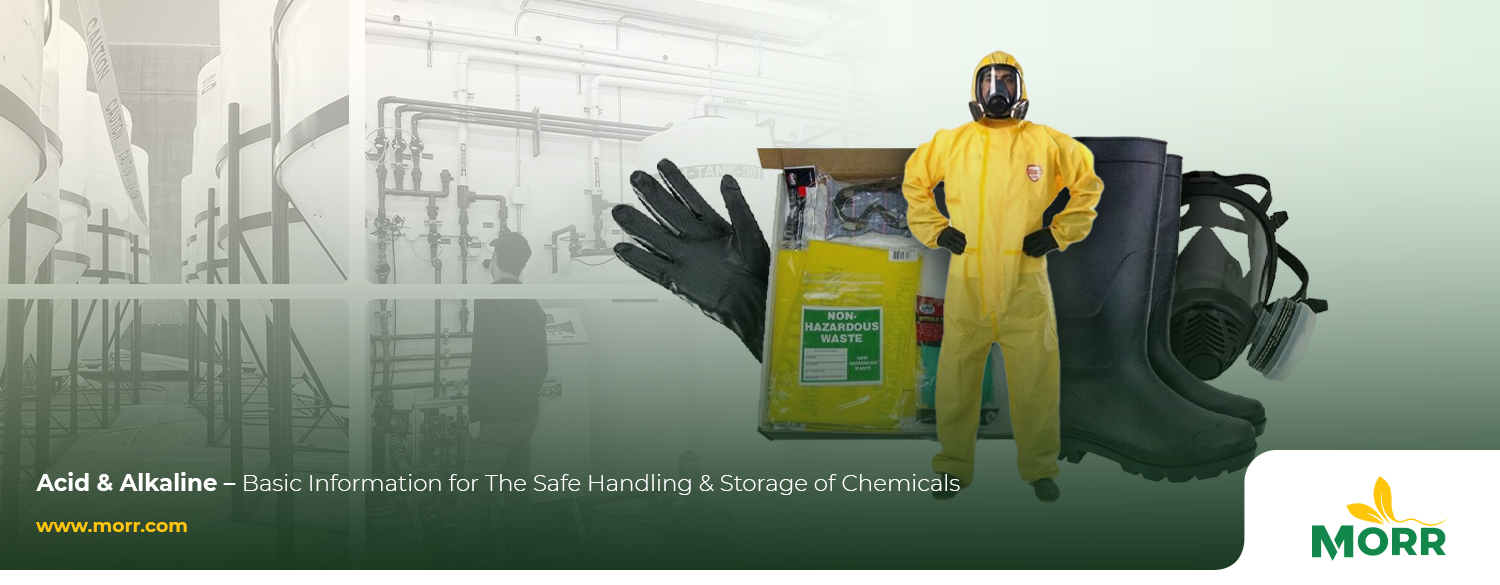
Acid & Alkaline – Basic Information for The Safe Handling & Storage of Chemicals
Acids and alkaline chemicals and products are commonly used in most agriculture and crop production facilities. Understanding the properties and hazards of these products is an important initial step in the safe handling, storage, use, and disposal of such products.
SAFETY PRECAUTIONS
Concentrated chemicals are strongly corrosive to all body tissue, especially eyes and skin. Concentrated acids are highly toxic due to their extreme corrosiveness. Hydrochloric and acetic acids are also toxic by inhalation. Always wear chemical splash goggles, chemical-resistant gloves and a chemical-resistant apron whenever using concentrated acids or acid solutions. Please review current Safety Data Sheets for additional safety, handling, and disposal information.
PURCHASE
Purchase dilute acids whenever possible. Dilute acid solutions are safer and easier to handle, use, and store, than concentrated acids. They will also save valuable prep time.
Purchase small quantities of acids to help keep your acid fresh and to make storage and handling safer and easier. It is easier to clean up a 100 mL acid spill than a 2.5 L one.
Always purchase concentrated acids in PVC-coated glass bottles. PVC-coated bottles will not shatter and spill acid when dropped. The PVC creates a plastic envelope around the bottle that greatly reduces spills and breakage. The PVC coating may discolor over time, especially when exposed to hydrochloric acid fumes. This discoloration does not affect the PVC coating or the quality of the acid inside the bottle.
STORAGE
Store all acids in a dedicated corrosives or acid cabinet. The best acid cabinets are built with wood because metal cabinets will quickly corrode from acid fumes. Wood cabinets will provide years of safe and durable acid storage. The cabinet should be in a locked chemical storeroom. If not, the cabinet must be secured with a lock.
Storing acids and bases together in one corrosive cabinet is acceptable. However, the bottles may become covered with ammonium chloride from the hydrochloric acid and ammonia fumes. The cabinet and bottles should be washed with TSP or other strong cleaner to remove the white film.
Label all prepared acid solutions before storing them with at least the name of the acid, its concentration, a hazard warning or how the acid can hurt you and the date prepared on the label.
Always keep the appropriate color-coded acid bottle cap on the concentrated acid bottle. Never use these caps on other bottles. Color-coded bottle caps provide an extra safety measure to identify concentrated acids if the label is removed or destroyed. If an acid bottle cap becomes cracked or discolored, always replace the cap with the proper color-coded cap. The following colors are used on all concentrated acid bottles sold in the United States.
- Acetic Acid—Brown
- Phosphoric Acid—White
- Hydrochloric Acid—Blue
- Sulfuric Acid—Yellow
- Nitric Acid—Red
- Ammonium Hydroxide—Green
Concentrated hydrochloric acid fumes continuously and cannot be stored without releasing hydrochloric acid fumes. These fumes are responsible for most of the corrosion damage in your chemical storeroom. Storing hydrochloric acid in a wood acid cabinet is a must. Hydrochloric acid fumes will quickly corrode metal cabinets.
Nitric acid is a strong oxidizing agent. Concentrated nitric acid must be stored in a separate liquid-tight compartment within an acid cabinet (e.g., SE8071). If nitric acid is mixed with a flammable organic compound, such as acetic acid, the heat from the oxidation and neutralization reactions is enough to ignite the flammable material. Nitric acid also slowly destroys its red plastic bottle cap. Always replace it with a new red cap. Nitric acid may also turn yellow over time because of the release of nitrogen dioxide on exposure to light. The yellow color does not affect the product’s usefulness for agriculture.
Glacial acetic acid is a flammable liquid. It should be stored in an acid cabinet, but in a location that is isolated from possible contact with nitric acid. Glacial acetic acid freezes at 16.6 °C; the material may crystallize in a cool storeroom. If this occurs, allow the bottle to warm up to ambient (25 °C) temperature.
Concentrated sulfuric acid is a strong dehydrating agent. Because of its strong ability to remove water, it reacts violently with many organic materials such as sugar, wood, and paper. If sulfuric acid has turned brown, it has probably been contaminated with an organic material and its purity should be in question.
Concentrated phosphoric acid has a melting point close to ambient temperature and may also crystallize in a cool storeroom. Phosphoric acid is hygroscopic and will absorb water over time. Keep tightly sealed.
TRANSPORTATION
Secondary containment is critical to prevent major spills or accidents when transporting acids. Use PVC-coated acid bottles when possible and when storing small quantities in a lab setting or for testing purposes. Unbreakable bottle carriers are another option.
A good habit is to check the acid bottle for cracks before touching or picking it up. Also check for spilled acid on the handle or bottle. Always carry 2.5-L acid bottles with one hand underneath the bottle and the other hand around the neck or finger hole. This keeps the bottle closer to your body and decreases the risk of hitting a sharp object, like a desk corner and breaking the bottle.
Plastic or rubber safety bottle carriers should be used whenever acids are transported from one laboratory to another or from the storeroom to a laboratory. If a cart is used to transport hazardous chemicals, such as acids, place compatible chemicals inside an unbreakable secondary containment vessel, such as a plastic tote. The cart should be equipped with guardrails to prevent plastic totes or bottles from sliding off the cart.
PREPARING & USING ACIDS & ALKALIS
Always review the Safety Data Sheet (SDS) before using or mixing any hazardous material.
Agriculture workers, PCA’s, QAL’s, plant scientists, agronomists, and others, should dispense acids from smaller bottles to limit spills and fumes. All too often we have seen workers attempting to pour directly from a 5- or 55-gallon vessel and all too often the results are not positive.
Use lab mats and or plastic trays when dispensing acids to contain acid spills and drips.
Dispense acids, especially hydrochloric, nitric, and acetic acids, in an operating fume hood.
During lab, set the acid bottle in a central dispensing location and have students bring a graduated cylinder or test tube to the dispensing area. This will help to minimize spills and accidents as well as limiting the amount of acid being transported back to the lab bench.
Instruct employees to only remove the amount of acid needed for the task from the reagent bottle. Chemicals are never added back to the reagent bottle.
Have acid spill clean-up materials readily available whenever acids are used.
Acids are corrosive and will eat through most fabrics, resulting in small holes in clothing. This process does not occur instantly but rather over several hours and may not become apparent until the clothes are washed. Always wear a chemical resistant apron or laboratory coat when working with acid.
PERSONAL PROTECTION EQUIPMENT & SAFETY AIDS
Nitrile rubber gloves are acid-resistant and are the best choice to use when handling concentrated acids. However, any plastic or vinyl glove will provide some protection against the occasional splash, small spill and splatter that may occur when using or dispensing acids.
Operating eyewashes must be available in any workplace or laboratory where acids or acid solutions are used. An approved eyewash must treat both eyes and provide clean potable water for at least 15–20 minutes.
Chemical splash goggles must be worn whenever acids or acid solutions are used. Safety glasses are not adequate protection.
Good ventilation should be available whenever hydrochloric, nitric, or acetic acids are used.
Spill control materials (sand, absorbent and neutralize must be available whenever acids or acid solutions are used.
FIRST AID
Always seek professional medical attention upon exposure to any hazardous chemical, especially concentrated acids.
The best first aid for any chemical exposure to body tissue or eyes is immediate dilution with water.
If an acid is splashed in the eyes, use eye wash to irrigate the eyes for at least 15–20 minutes. Make sure the eyelids are held open to properly irrigate them. Ask the victim to look up, down and sideways to better reach all parts of the eye.
If an acid is splashed onto bare skin, rinse with water for at least 15–20 minutes.
If an acid is splashed onto clothing, consider removing the clothing immediately before the acid soaks through the clothing and reacts with the skin. If an acid splashes onto your skin and clothing, immediately begin rinsing the affected areas with water (safety shower is ideal) and then begin to remove affected clothing. Modesty must take a back seat to the potential chemical burns that can occur.
If acid is ingested, the primary goal is to dilute the acid in the stomach and prevent further injury caused by vomiting. If the victim is conscious, immediately have the victim rinse their mouth out with water. Have the victim drink one or two cups of water or milk. Gastric antacids such as milk of magnesia or aluminum hydroxide can also be given. Do not induce vomiting, do not try to neutralize the acid with a strong base, and do not give the victim any sodium bicarbonate or any carbonated drinks. Call a poison control center or hospital emergency room and follow their directions.
Both acids and alkalis are corrosive and react with or eat away materials with which they come in contact. This means that they will oxidize and corrode metals and metal oxides and can have serious ramifications when they encounter skin, lung tissue, and other organic material. This is the most significant toxic action produced by these chemicals. The severity of this corrosive action depends on the strength of the acid or alkali, the concentration of the chemical, the temperature of the chemical, and the duration of contact.
Strong acid/alkali should never be used without wearing eye protection such as safety glasses or a face shield. Other personal protective equipment should also be used to prevent contact with skin or clothing. This would include appropriate gloves, as well as a lab coat or apron. If contact occurs with skin or eyes, those areas should be flushed with copious amounts of water.
The primary technique for preventing inhalation exposure should be the use of local exhaust ventilation such as a laboratory hood to prevent the aerosol or vapor from reaching the breathing zone. In those cases where local ventilation is not possible, a NIOSH certified respirator specific for the exposure can be used as part of a respiratory protection program.
Proper laboratory practices as described in several laboratory handbooks should be followed. These practices include adding acid/alkali to water so that any splash will be primarily the water. Also, constant stirring and slow addition will reduce heat build-up when mixing these chemicals with other substances including water.
MORR, Inc. offers a wide array of chemicals, worker protection, and other products for those in need of chemicals and the safe handling of such chemicals. Some of our products and product categories can be found below:
EYE PROTECTION
Eyewash station
Eyewash replacement bottles
Safety glasses
Goggles
Face shield
HAND PROTECTION
Nitrile Gloves
Neoprene Gloves
Split palm leather gloves
Leather driver gloves
Nylon knit shell gloves
FOOT PROTECTION
PVC Boots
Shoe covers
Shoe cover dispensers
Sanitizing foot bath mats
Shoe cover remover
LUNG PROTECTION
Full face masks
Half face masks
Replacement cartridges including P100, Organic vapor, etc.
R95 valved particulate respirator
PROTECTIVE CLOTHING
Coveralls
Aprons
Lab coats
Sleeves
Rain jackets and pants
Hairnet
Beard Guard
Basic protection coverall
Medium protection coverall
Premium protection coverall
CHEMICAL TANKS & RESERVOIRS
Poly Drums
Dikes
Spill containment basins
Spill containment pallets
Spill containment vessels
Spill basins
Drum bibbs and funnels
ACCESSORIES
Drum pumps
Poly drum bung adapters and converters
Emergency chemical spill cleanup kit
Absorbent pads
CHEMICALS
Isopropyl alcohol
Calcium Chloride
Potassium bicarbonate
Potassium silicate
Sodium hypochlorite (Bleach)
Hydrogen peroxide H2O2
Sulfuric acid
Ethanoyl
Hydrochloric acid
Acetone
Nitric acid
Citric acid
Diesel exhaust fluid (DEF)
Potassium carbonate
Sodium hydroxide
Sodium metabisulfite
Caustic soda
Potassium sorbate
Sodium benzoate
Click here to shop our vast selection of chemical tanks and PPE products

About
MORR Inc.
MORR Inc. is a wholesale commercial agriculture distributor for planting, growing, and farming located in Los Angeles, CA. MORR Inc. supplies top of the line wholesale commercial hydroponic systems, commercial grow systems, a wide selection of grow lights and automated control systems, nutrient rich soils and growing media, a large selection of specialized advanced plant nutrients for different plant life cycles, dosing and drip irrigation systems, high tech environmental meters and automated systems, fans, filters, plant pesticides, plant fungicides, automated crop management systems, general commercial grow facility supplies and services, plus much more!
Call- 1-310-967-2022