A GUIDE TO GREENHOUSE HAF FANS, LAYOUT, AND INSTALLATION
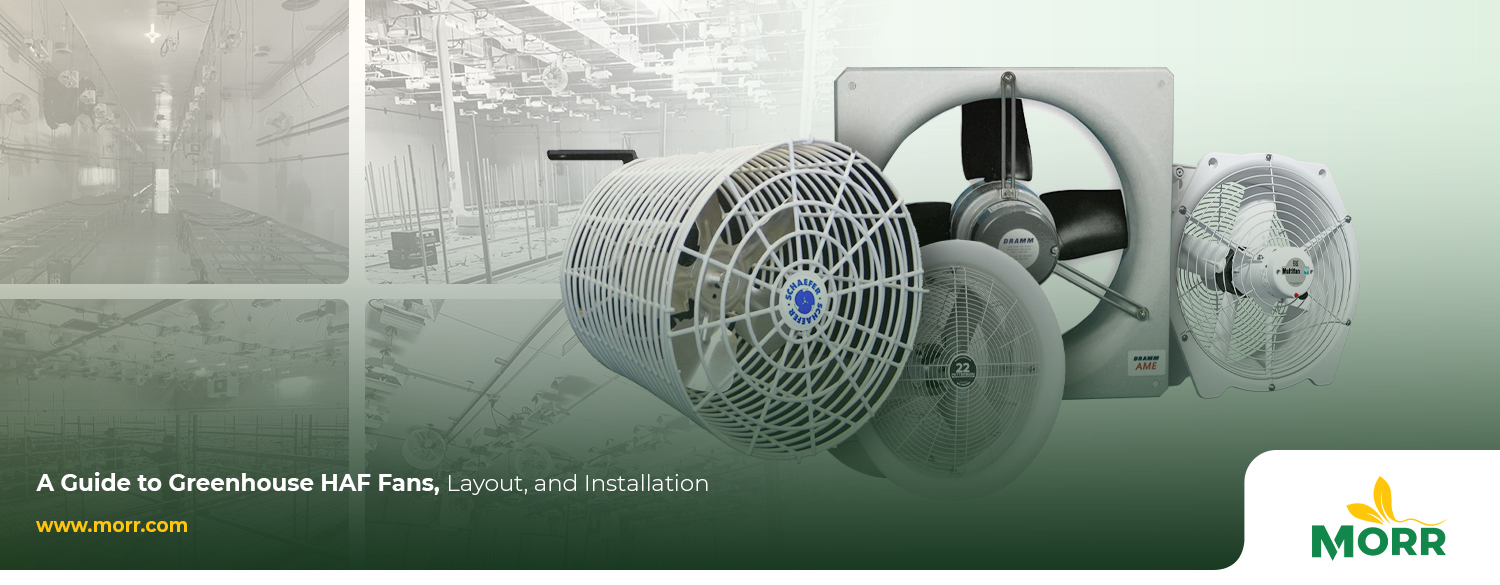
GREENHOUSE HAF FANS
Greenhouse HAF Fans are produced by an array of companies around the world. There are many styles, sizes, specifications, and options to choose from that complicate the selection process for farm managers seeking the best return on investment products. This article is designed as a guide for commercial crop production facilities and their staff when selecting greenhouse or indoor controlled environment agriculture fans. It is important that crops in the greenhouse grow evenly. By circulating air using quality HAF products growers can expect uniform greenhouse climate, lower rates of plant disease, and increased production.
WHAT TO CONSIDER WHEN SELECTING GREENHOUSE AND INDOOR HAF FANS
When deciding on which fan is the correct fit for your cultivation facility there are a few important considerations. Country of origin is important for pricing, quality, and obtaining spare parts. We put fans into two major categories, China/Developing markets, and European/American/Canadian products.
While the pricing can be enticing from Chinese fan manufacturers, we have not yet seen the product quality, efficiency, and duration of use, match the metrics we expect in high quality US, European, and Canadian manufacturers. It is our belief that any premium paid for quality fans is quickly recuperated and continues to pay a dividend as the fans perform years longer than Chinese and emerging market products. It is not uncommon for low quality products to begin failing after 3 to 5 years while high quality HAF fans will last anywhere from 15 year and up.
When operating a motor in a high humidity, high/low temperature, demanding environment we have not found that products produced in developing countries meet the standards we are accustomed to. This translates into a bad return on investment to the grower and to the farm and since the price difference is not that great it doesn’t make sense to cut corners.
MEET SCHAEFER AND VOSTERMAN HAF FANS AND PRODUCTS
When comparing US and European fan options there are overlapping strengths with subtle differences. Considering efficiency, cost, and performance we have two preferred partners for HAF fans, one made in America and the other originating in the Netherlands.
Schaefer Ventilation is the largest and most prevalent manufacturer of greenhouse fans in the US. They have options ranging from 8-Inch all the way up to 72-Inch and everything in between. Most products come in a range of voltages and phases for single phase 120V through three phase 480V. Three popular products are:
- Versa-Kool Fans – The best priced Horizontal Air Flow (HAF) fan globally considering the quality. It is not uncommon to find these fans in greenhouses that are over 15 years old and still spinning like new.
- Floor Fans – Schaefer has several lines of floor fans including a High Velocity Floor Fan, Fan Cart, and the lower cost Remmington. Drum fans are also excellent options for post-harvest processing, aisles, and open spaces.
- Twister Oscillating Fans – Although not commonly installed in greenhouses, we find some indoor farms require oscillating fans in certain applications. The Twister is available in several sizes and moves high volumes of air at low amp draw.
All the accessories such as guards, fan blades, cords, mounting brackets, etc. are available from the same company. This ensures spare parts, motor repair, and replacements are available in a timely manner. All too frequently we have had to tell customers of non-domestic products it will be 60-90 days until your parts arrive.
Since 1952, Vosterman Ventilation, a Dutch company, has been successfully helping companies in the agricultural sector with efficient and reliable ventilation solutions. They are our selection for customers seeking European fans due to their precision manufacturing, efficiency, and ergonomic designs. Three popular products are:
- Multifan HAF – Horizontal Circulation Fans mix the air above plants at a high speed from fan to fan.
- Panel Fan – These fans are thin and often used in vertical grow rooms since they fit on multi-tiered racks with minimal footprints.
- V-Flo Vertical Air Flow Fan – This fan mixes the air vertically by taking warm air above the crop and blending it with cooler air in the canopy and below the crop.
Manufacturers that focus on fans and fans alone are generally more innovative and obsessed with efficiency. They strive to create a better product and are acutely aware of the choices they make. It is not uncommon to find turnkey greenhouses furnished with Vosterman fans due to their recognition in the market as a high-quality product at a fair price.
WHAT IS THE DIFFERENCE BETWEEN HAF FAN MOTORS?
The most important part of the fan is the motor. There are two variables that we consider when analyzing Horizontal Airflow Fan motors:
- Efficiency – How much electrical consumption is required to generate a specific CFM. Two fans could each produce 5000 CFM but one could do so at reduced operating costs while the other will draw more electricity to achieve the same output. Since fans should last over 10 years and run most of the day the efficiency story is crucial.
- Duration of Use – Quality components are essential to ensure motors continue to perform for a decade plus. Since neither you nor I are motor manufacturers and we do not know/understand the differences between similar looking products, it is important to rely on quality companies recognized as leaders in the field.
Companies that pop-up and claim to offer the same efficiency standards as the leading manufacturers typically don’t last. There is only room for so many brands of products and since the major providers have been around for decades, have loyal customers, and have a solid legs to stand on, it is much safer investing with them as opposed to second and third tier companies that may have a good product at an inflated price or as more commonly found to be the case, a poor product at a reduced price point. Manufacturers don’t cut margin to lower the price, they cut quality. This directly translates into higher fail rates and shorter running hours.
WHAT IS THE IDEAL ELECTRICAL SPECIFICATION FOR HAF FANS?
Another consideration when it comes to motor selection is voltage and phase. The most common options are 1-phase 240V and 3-phase 240V/277V. Single phase 240V products are the best price point while 3-phase 240V or single phase 277V offer lower amp draw and more efficient operation. It is not uncommon for a single phase 240V fan to cost around $200 and a three phase or 277V fan to cost $450. Although the difference will be made up in electrical savings it is hard to justify the upfront cost associated with higher voltage HAF fans.
HOW TO PROPERLY LAYOUT GREENHOUSE HAF FANS FOR OPTIMAL AIRFLOW?
Before laying out your fans it is important to consider the placement of other equipment sharing the space. For example:
- Cooling pads and HVAC suction/return lines
- Benching system and rolling table layout
- Placement of horticultural lighting
- The placement of humidification and dehumidification systems
- The maximum height for your crop
- Ceiling height or gutter/peak height
- Total volume of air in the space
- Any exhaust fans, floor fans, or other air movers
In most instances the goal of HAF fans is to move air across the canopy in a consistent and predictable way. There should not be areas of high and low velocity air flow, nor should there be dead spots. To achieve uniformity, we suggest our customers follow a tried-and-true layout with modifications to accommodate their specific installation.
The most common setup moves air in reversing lanes that blow back-and-forth across the length of growing space. For example, in a 30’ x 100’ greenhouse running north/south, the first row of fans starts in the south and blow north across the 100’ length. The first fan would be approximately 4’ off the southern wall and 4’ off the side wall facing north. The next fan would be 30’ in front of the first fan at 34’ north of the southern wall, in line with the first fan, blowing from south to north as well. The third fan would be 30’ in front of the second fan at 64’ north of the southern wall, in line with the first two fans, blowing from south to north as well. Therefore, the first row contains three 20-inch or 24-inch HAF fans spaced 30’ apart all blowing from south to north.
The second row of fans would be approximately 10’ away from the first row and would blow from north to south (In the opposing direction). This row would be laid out the same way with three fans inline at 30’ spacing from one another.
The third row of fans would blow from south to north, in the same direction as the first row, and again would contain three inline fans 30’ apart from one another.
This layout would be appropriate for most greenhouses that have more than 12’ gutter height or at least 3 feet of space between where the fan will be mounted and the top of the canopy at crop maturity.
The first fan is placed approximately 4’ off the wall to ensure it can blow the maximum CFM without getting choked. Too often we have seen fans against the wall, only on a bracket, and putting out reduced levels of air. In these cases, we tell the operator the fan is not the issue, if you simply move the fan a few feet off the wall it will begin operating at higher output levels as desired.
We suggest the fan be positioned approximately 4’ off the side wall as fans that are too close to the side walls lose output due to friction. When positioned correctly, less fans will be needed overall, and their output will be unhindered.
The fans are positioned inline, at 30’ to 60’ spacing, depending on crop type and desired airflow. For tall crops with a dense canopy, it is suggested to keep spacing closer to 30’. For shorter crops that do not benefit as much from high air flow spacing can be reduced to something closer to 60’. Around 60’ away from the fan, volume and velocity of air begins to fall off and uniformity will be impacted.
Although HAF fans are called Horizontal Air Flow products, they move air vertically as well when installed correctly. The lanes of airflow will blow evenly across the canopy in a predictable and unobstructed manner. Where the opposing lanes of air meet there will be friction that pushes the air down through the canopy. So, if the first lane is blowing south to north and the second lane is blowing north to south, there will be friction between them due to the opposing directions of fast-moving air, and this friction will drive air down vertically through the canopy.
Additionally, when fans are positioned several feet off the wall, they will draw air from behind them and this will draw up cooler air near the floor and warmer air near the lights or apex. When air hits the far wall of the greenhouse it will be pushed in all directions as well and picked up by the lanes around it and drawn back down the length of the grow space.
In our example of the 30’ x 100’ greenhouse there would be 3 lanes of 3 fans for a total of 9 fans. If additional air flow was desired the lanes could be reduced to 8’ and the space off the walls reduced to 3’ and another lane could be added for a total of 4 lanes of 3 fans totaling 12 fans.
The most common fan size is the 20-inch, followed by the 24-inch. This is due to the larger diameter pattern they will blow, price points, CFM, and upfront cost. Smaller fans are often not strong enough and larger models can get expensive. 20-inch and 24-inch fans have excellent output and small amp draw.
WHAT IS THE BENEFIT OF VARIABLE SPEED FANS AND SPEED CONTROLLERS?
Most fans operate at fixed speeds and are either on or off. Some installers put half the fans on one switch and the other half on another switch so they can be run 50% or 100% on/off. In instances where demand can change and there may be times where low airflow or high airflow are desired, speed controllers can be wired in and should be used.
When using single phase fans, we suggest using the [VAA100] Arable Acres FanFlow Manual Variable Speed Control - On/Off Toggle Switch - RFI Filter - 115/230V (4 Fans @ 230V). This speed controller can be used up to a certain amp draw so check fan nameplate amps to determine how many fans can be connected to a single controller. Multiple controllers can be used.
For three phase fans and VFD compatible fans a VFD can be used to control the motor and slow down or speed up fans as desired. An example of this product would be [WYAS050] Variable Frequency Drive - LED Display - 3 Phase 230V Input - 12-amp Maximum Continuous Duty - 4 HP.
FREE FAN LAYOUTS AND GREENHOUSE DESIGN SERVICES
MORR, Inc. offers free exhaust and HAF fan layouts for projects of all sizes and shapes. We can assist in determining what voltage and phase would make the most sense, where fans should be placed, and whether mounting brackets, speed controllers, or other accessories are required.
Here is a simple example of a layout for a specific customer installation:
 Wholesale HAF Fans-
Click here to shop our entire selection of commercial-grade greenhouse fans and HAF Fans

About
MORR Inc.
MORR Inc. is a wholesale commercial agriculture distributor for planting, growing, and farming located in Los Angeles, CA. MORR Inc. supplies top of the line wholesale commercial hydroponic systems, commercial grow systems, a wide selection of grow lights and automated control systems, nutrient rich soils and growing media, a large selection of specialized advanced plant nutrients for different plant life cycles, dosing and drip irrigation systems, high tech environmental meters and automated systems, fans, filters, plant pesticides, plant fungicides, automated crop management systems, general commercial grow facility supplies and services, plus much more!
Call- 1-310-967-2022