A GUIDE TO CUTTING, TRIMMING, AND SHEARING TOOLS IN CROP PRODUCTION
A GUIDE TO CUTTING, TRIMMING, AND SHEARING TOOLS IN CROP PRODUCTION
Our state-of-the-art pruning tools are designed to be ergonomic, super lightweight, and perfectly balanced for continuous use. No steel is as hardened and therefore suited for agricultural tools as the Japanese steel we put into our blades. By combining superior sharpness and high-quality inputs our tools are the industry’s longest lasting and therefore best return on investment (ROI).
SCISSORS
Scissors are popular for manual operation, both when contracting and retracting blades. The lack of a spring or other opening/closing mechanism ensures the blades do not move without the operators intending them to do so. This gives the operator complete control and the ability to choose between very small or medium blades. Plant Scissors come with a variety of handles to choose from and can fit most trimming applications.
APPLICATIONS: Trimming, small cuts, frequent and high repetition cutting, fruit snipping, cut flowers, and other soft tissue, small diameter cutting
CROPS: Hemp, leafy greens, bonsai, flower
HAND-HELD PRUNERS & TRIMMING SHEARS
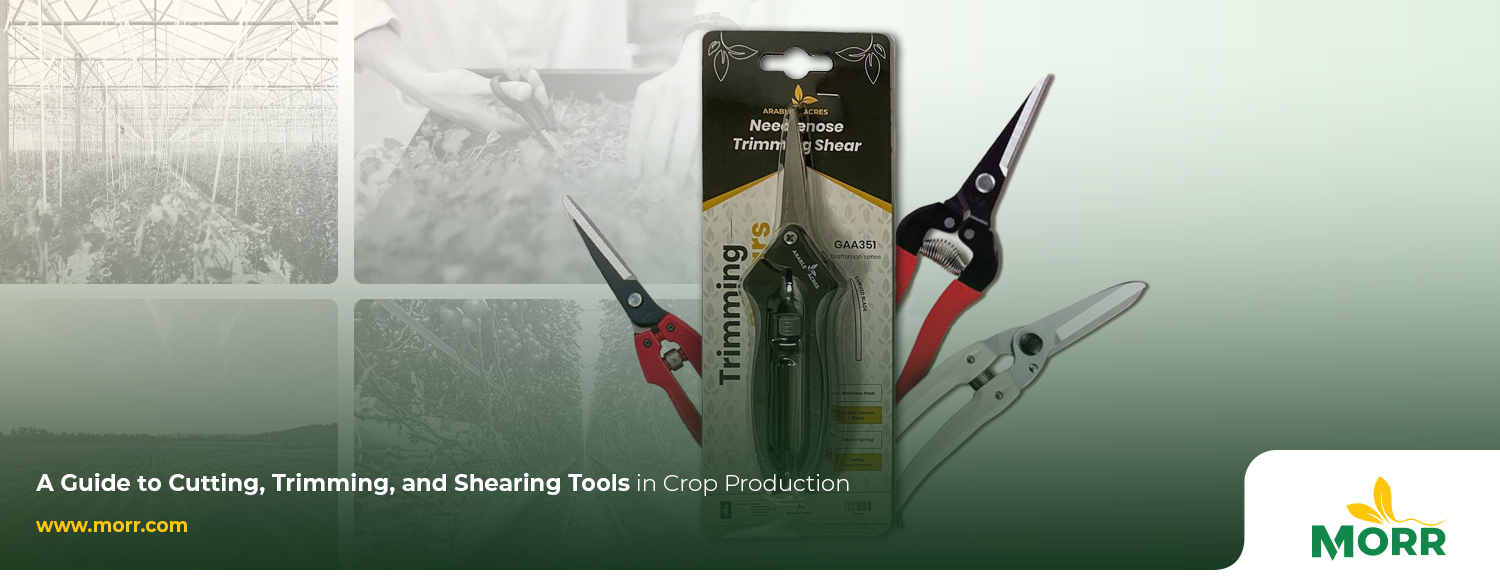
Hand-held pruners and trimming shears are like scissors in that they are controlled with one hand and can carry small blades but differ in that they use springs to assist in opening the shear. This prevents the blade from sticking shut and increases the speed at which tasks can be completed. Hand-held pruners and shears can come with small or medium blades in an array of orientations for different tasks. Needlenose trimming shears have long narrow blades for sniping tight spaces and hard to reach areas while fruit pruners have a rounded tip to prevent worker injuries and allow for finger guiding when trimming in non-visible areas.
APPLICATIONS: Trimming, small cuts, frequent and high repetition cutting, fruit snipping, cut flowers, and other medium/soft tissue, medium/small diameter cutting
CROPS: Tomato, cucumber, pepper, avocado, citrus, veggies, fruits, coffee, grapes, hemp, leafy greens, bonsai, flower
ANVIL & BYPASS PRUNERS
Anvil and Bypass pruners are for thicker and harder foliage that requires additional force to cut. The blades are designed in a way that focuses all applied energy toward the blade and pushing it through thick, hardened branches.
Q: What is the difference between Anvil and Bypass Pruners?
A: Anvil type shears have only one single cutting blade that closes against a flat steel anvil or lower jaw. Rather than providing a smooth cut, anvil type trimming shears crush the branch between the sharp blade and the anvil. Bypass type shears, like scissors, have two blades that cross over each other when trimming. They are the most common style of shear and usually have curved blades which assist in getting into hard-to-reach spaces and making precision cuts. The dual blades result in cuts that are smooth and clean.
For thick and hard to cut branches, too small for a saw or looper, but too large or hard for bypass shears, an anvil pruner is the tool of choice. For continuous cutting of medium/small diameter foliage and medium-soft branches a bypass pruner would generally be preferred.
APPLICATIONS: Branch removal, post-harvest cut down, fruit harvesting, pruning, vineyard wintering
CROPS: Tomato, cucumber, pepper, avocado, citrus, veggies, fruits, coffee, grapes, hemp, leafy greens, bonsai, flower
HEDGE SHEARS
Hedge shears are ideal for landscaping applications that require straight cuts to sculp plants. Hedge clippers or trimmers are generally used on decorative shrubbery. They are used to remove several small branches of a tree, bush, or hedge simultaneously in a single cut. They therefore have long overlapping blades and longer handles for easy guiding and repeat strokes.
APPLICATION: Landscape, decorative shrubbery, leaf removal
CROPS: Landscape, nursery
LONGREACH PRUNERS
Long reach pruners, also known as telescopic pruners, are used for the safe removal of fruits and branches that would otherwise be out of reach or require a ladder. These blades sit atop long handles that allow the operator to identify and remove foliage and fruits that are above the height reachable by a standing person with their arms raised. Depending on the length of the pole, it is not uncommon to be able to reach branches that are 8 feet or more above what could be reached with ordinary loppers or pruners.
APPLICATION: Fruit trees, nut trees, tall vine crops, landscaping, thick branches
CROPS: Avocado, pistachio, almond, cashew, apricot, pear, apple, plumb, orange, lemon, tangerine, grapefruit, olive, trees, hedges
LOPPERS
Lopper type pruners are anvil or bypass pruners on steroids. They have longer handles and enlarged blades for additional cutting strength. Loppers are used on branches between 1/2 to 1-inch diameter (1cm to 2.5cm) to not damage the blades on smaller, hand-held trimming shears. Long handles add leverage for hardened wood branches and offer longer reach for a wider range of operation. Although less effort is required to make cuts it is necessary to use two hands.
APPLICATION: Fruit trees, nut trees, tall vine crops, landscaping, thick branches
CROPS: Avocado, pistachio, almond, cashew, apricot, pear, apple, plumb, orange, lemon, tangerine, grapefruit, olive, trees, hedges
SAWS
Saws are for thicker branches that cannot be severed by squeezing blades together. Generally, branches 1-inch and over are cut with saw blades moved back and forth across the branch until breach. Folding saws are great for compact transport and offer solutions for smaller branches. Fixed saws are better for continuous and repetitious cutting of medium to large branches. Pole saws offer extended reach for branches that are above a person’s ability to access while standing. Saws generally have replaceable blades to ensure long duration of use and faster cutting.
APPLICATION: Thick branch removal, tree removal, multi-season crop removal
CROPS: Trees of all variety, large bushes
ACCESSORIES
Pruners, trimming shears, loppers, and saws all require transport, protection, and sharpening. Therefore, it is suggested to implement pouches, tension leg straps, cases, and sharpening stones. Having a designated place for hand-held pruning shears reduces the instances of loss and theft. Keeping your shears on your belt or leg ensures you know exactly where they are, feel maximum comfort during transport, and can safely and efficiently deploy them for use. Sharpening stones and replacement parts such as replacement saw blades are crucial for speeding up cut time and ensuring reduced effort and fatigue.
CATEGORIES-
SHEARS
- Scissors
- Hand Pruners
- Hedge Shears
- LongReach Pruners
- Loppers
SAWS
- Folding Saws
- Fixed Saws
- Pole Saws
- Saw Blades
SPECIALTY
- Master Gardner
- Floral
- Bonsai
- ARSuper Shears
ACCESSORIES
- Pouches
- Sharpening Stones
- Tension Leg Straps
BLADE TYPES AVAILABLE-
High Carbon Tool Steel Blade
Typically, 0.98 to 1.10% carbon. This steel is harder than many others and consequently holds an edge well. This is one of the best steels to use for holding an edge.
Stainless Steel Blade
Rust-resistant stainless-steel blades contain high levels of chromium, vanadium, and molybdenum. Less care and maintenance are required. The alloys in stainless steel impart a higher wear-resistance to the blade making it more durable than carbon steel in this respect.
Drop Forged Blade
This involves hammering hot steel into dies and is also known as impact impression or die forming. Excess material (Flash) gets squeezed out the sides of the mold and is trimmed away. Drop forged blades are more durable than stamping or machined knives.
Hard Chrome Plated Blade
Hard chrome plating, also called chromium plating, is an electroplating process in which a layer of chromium is deposited onto a surface. This layer of chromium protects and extends the life of the part by improving wear resistance, reducing the coefficient of friction, and increasing mild corrosion resistance.
Chemical Nickeled Blade
This is a trade secret proprietary electroless nickel boron, nickel phosphorus plating system that is comprised of boron, nickel, phosphorus and other metals which produce an extremely hard, wear resistant, corrosion resistant surface with a very low coefficient of friction.
Replaceable Blade
This is important to know as these shears, saws, and pruners will be usable for extended periods of time. Blades can be sharpened and then once used up replaced.
Impulse Hardened Blade
Also known as hardpoint saws, these tools have teeth that undergo a hardening process to ensure they stay sharper for longer.
Curvature Ground Blade
These blades provide the highest level of precision with the least amount of pinching. For use when accuracy and control are essential. Blades have a curved shape which allows them to follow the natural contours of branches.
Tapered Blade
Thicker at the base and thinner at the tail. The edges are therefore not parallel. Tapered blades reduce friction or drag while increasing the direction of energy toward the cut point.
Click here to shop our entire selection of commercial-grade cutters, trimmers, shears

About
MORR Inc.
MORR Inc. is a wholesale commercial agriculture distributor for planting, growing, and farming located in Los Angeles, CA. MORR Inc. supplies top of the line wholesale commercial hydroponic systems, commercial grow systems, a wide selection of grow lights and automated control systems, nutrient rich soils and growing media, a large selection of specialized advanced plant nutrients for different plant life cycles, dosing and drip irrigation systems, high tech environmental meters and automated systems, fans, filters, plant pesticides, plant fungicides, automated crop management systems, general commercial grow facility supplies and services, plus much more!
Call- 1-310-967-2022