
Lida Plant Research Stimfruit - 0-25-32 - Fruit Set and Size Promoter


About this product
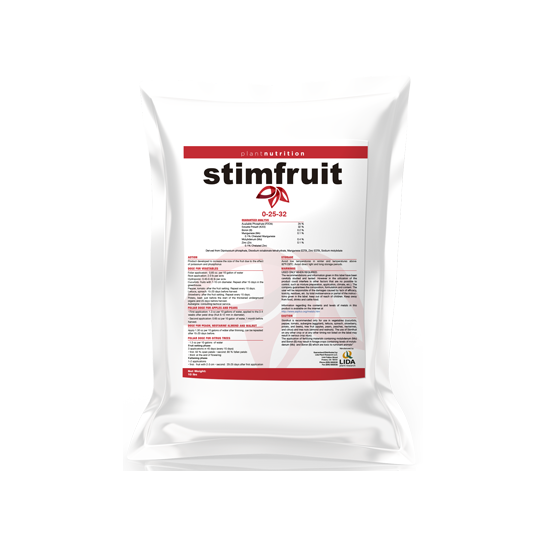
Stimfruit is a solid fertilizer formulation containing 0% Nitrogen, 25% Available Phosphate (P₂O₅), and 32% Soluble Potash (K₂O), with a guaranteed analysis of Boron (B) 0.2%, Manganese (Mn) 0.1% (0.1% chelated), Molybdenum (Mo) 0.4%, and Zinc (Zn) 0.1% (0.1% chelated). The product is derived from dipotassium phosphate, disodium octaborate tetrahydrate, manganese EDTA, zinc EDTA, and sodium molybdate. It is developed to increase fruit size through the action of potassium and phosphorus.
Chemical Composition and Formulation
The product is a solid with a pale yellow color. It has a pH of 7.4 at 0.1% dilution. The formulation contains disodium octaborate tetrahydrate at a concentration of 0.3% to 2.5%, which is classified as Repr. 1B, H360FD (may damage fertility and the unborn child). Under Regulation (EC) No 1272/2008, the mixture is classified as Repr. 1B with the signal word Danger and hazard statement H360FD. Precautionary statements include P201 (obtain special instructions before use), P202 (do not handle until all safety precautions have been read), P280 (wear protective gloves/protective clothing/eye protection/face protection), P308+P313 (if exposed or concerned: get medical advice/attention), P405 (store locked up), and P501 (dispose of contents/container appropriately). The product carries the EUH statement "Restricted to professional users."
Target Crops
Stimfruit is recommended for use on vegetables (cucurbits, pepper, tomato, aubergine/eggplant, lettuce, spinach, strawberry, potato, beet), tree fruit (apples, pears, peaches, nectarines, citrus), and tree nuts (almond, walnut). Use on any other crop or at any timing not listed on the label may result in serious crop injury.
Application Specifications
Vegetables – Foliar Application
-
Rate: 0.65 oz per 10 gallons of water
Vegetables – Root Application
-
Rate: 2.0 lb per acre
Vegetables – Hydroponic Application
-
Rate: 0.40 to 0.45 lb per acre
Vegetables – Crop-Specific Timing
-
Cucurbits: Apply when fruits reach 7 to 10 cm diameter. Repeat after 15 days in greenhouse.
-
Pepper, tomato: Apply after fruit set. Repeat every 15 days.
-
Lettuce, spinach: Apply 15 to 20 days before harvest.
-
Strawberry: Apply after fruit set. Repeat every 15 days.
-
Potato, beet: Apply just before the start of thickened underground organ development and again 20 days before harvest.
-
Aubergine (eggplant): Consult technical service.
Apples and Pears – Foliar Application
-
First application: 1.3 oz per 10 gallons of water, applied 3 to 4 weeks after petal drop when fruit diameter is 8 to 12 mm.
-
Second application: 0.65 oz per 10 gallons of water, applied 1 month before harvest.
Peach, Nectarine, Almond, Walnut – Foliar Application
-
Rate: 1.3 oz per 10 gallons of water, applied after thinning. Repeat after 15 to 20 days if needed.
Citrus Trees – Foliar Application
Fruit Setting Phase: 1.3 oz per 10 gallons of water. Apply 3 applications over 45 days (every 15 days): first at 50% open petals, second at 80% fallen petals, third at the end of flowering.
Fattening Phase: 1.3 oz per 10 gallons of water. Apply 1 to 2 applications: first when fruit reaches 2 to 3 cm diameter, second 20 to 25 days after first application.
Use Restrictions and Warnings
Use only when required. Do not exceed the recommended rate. Application of fertilizing materials containing molybdenum and boron may result in forage crops containing levels of molybdenum and boron toxic to ruminant animals. The user is responsible for any damages caused by lack of efficacy, toxicity, or residues due to failure to follow label instructions.
Storage and Handling
Store in a dry, well-ventilated place between 5°C and 25°C (41°F to 77°F), away from sources of heat and direct sunlight. Avoid low temperatures in winter and temperatures above 82°F (28°C). Avoid direct light and long storage periods. Keep away from oxidizing agents and highly alkaline or acidic materials. Keep containers closed and placed vertically when not in use. Keep out of reach of children. Keep away from food, drinks, and cattle feed.
Safety and Personal Protective Equipment
Wear protective gloves (PVC, 0.35 mm thickness, >480 minute breakthrough time), protective goggles against particle impacts, chemical protective clothing, and safety footwear. Use a particle filter mask (P2) when ventilation is inadequate. In case of eye contact, remove contact lenses and wash eyes with clean, cool water for at least 10 minutes while holding eyelids open. For skin contact, remove contaminated clothing and wash vigorously with water and soap. Do not use solvents or thinners. If swallowed, seek immediate medical attention; do not induce vomiting. If inhaled, move victim to open air; keep warm and calm; perform artificial respiration if breathing is irregular or stops. Store locked up.
Environmental Precautions
Do not allow product to enter sewers or waterways. Prevent penetration into the ground. Contain and collect spills with inert absorbent material (earth, sand, vermiculite, diatomite). Clean area immediately with a suitable decontaminant. Dispose of waste according to local and national regulations.
Firefighting Measures
The product is not classified as flammable. Suitable extinguishing media include powder, CO₂, alcohol-resistant foam, and water spray. Do not use a direct stream of water. In the presence of electrical voltage, do not use water or foam.
Compliance
Information regarding the contents and levels of metals in this product is available at http://www.aapfco.org/metals.html. The product is not affected by SEVESO III Directive 2012/18/EU.
-
 NLPR027 Lida Plant Research Stimfruit - 0-25-32 - Fruit Set and Size Promoter - 2 Pounds
 -
NLPR028 Lida Plant Research Stimfruit - 0-25-32 - Fruit Set and Size Promoter - 10 Pounds
Details
Stimfruit is a solid fertilizer formulation containing 0% Nitrogen, 25% Available Phosphate (P₂O₅), and 32% Soluble Potash (K₂O), with a guaranteed analysis of Boron (B) 0.2%, Manganese (Mn) 0.1% (0.1% chelated), Molybdenum (Mo) 0.4%, and Zinc (Zn) 0.1% (0.1% chelated). The product is derived from dipotassium phosphate, disodium octaborate tetrahydrate, manganese EDTA, zinc EDTA, and sodium molybdate. It is developed to increase fruit size through the action of potassium and phosphorus.
Chemical Composition and Formulation
The product is a solid with a pale yellow color. It has a pH of 7.4 at 0.1% dilution. The formulation contains disodium octaborate tetrahydrate at a concentration of 0.3% to 2.5%, which is classified as Repr. 1B, H360FD (may damage fertility and the unborn child). Under Regulation (EC) No 1272/2008, the mixture is classified as Repr. 1B with the signal word Danger and hazard statement H360FD. Precautionary statements include P201 (obtain special instructions before use), P202 (do not handle until all safety precautions have been read), P280 (wear protective gloves/protective clothing/eye protection/face protection), P308+P313 (if exposed or concerned: get medical advice/attention), P405 (store locked up), and P501 (dispose of contents/container appropriately). The product carries the EUH statement "Restricted to professional users."
Target Crops
Stimfruit is recommended for use on vegetables (cucurbits, pepper, tomato, aubergine/eggplant, lettuce, spinach, strawberry, potato, beet), tree fruit (apples, pears, peaches, nectarines, citrus), and tree nuts (almond, walnut). Use on any other crop or at any timing not listed on the label may result in serious crop injury.
Application Specifications
Vegetables – Foliar Application
-
Rate: 0.65 oz per 10 gallons of water
Vegetables – Root Application
-
Rate: 2.0 lb per acre
Vegetables – Hydroponic Application
-
Rate: 0.40 to 0.45 lb per acre
Vegetables – Crop-Specific Timing
-
Cucurbits: Apply when fruits reach 7 to 10 cm diameter. Repeat after 15 days in greenhouse.
-
Pepper, tomato: Apply after fruit set. Repeat every 15 days.
-
Lettuce, spinach: Apply 15 to 20 days before harvest.
-
Strawberry: Apply after fruit set. Repeat every 15 days.
-
Potato, beet: Apply just before the start of thickened underground organ development and again 20 days before harvest.
-
Aubergine (eggplant): Consult technical service.
Apples and Pears – Foliar Application
-
First application: 1.3 oz per 10 gallons of water, applied 3 to 4 weeks after petal drop when fruit diameter is 8 to 12 mm.
-
Second application: 0.65 oz per 10 gallons of water, applied 1 month before harvest.
Peach, Nectarine, Almond, Walnut – Foliar Application
-
Rate: 1.3 oz per 10 gallons of water, applied after thinning. Repeat after 15 to 20 days if needed.
Citrus Trees – Foliar Application
Fruit Setting Phase: 1.3 oz per 10 gallons of water. Apply 3 applications over 45 days (every 15 days): first at 50% open petals, second at 80% fallen petals, third at the end of flowering.
Fattening Phase: 1.3 oz per 10 gallons of water. Apply 1 to 2 applications: first when fruit reaches 2 to 3 cm diameter, second 20 to 25 days after first application.
Use Restrictions and Warnings
Use only when required. Do not exceed the recommended rate. Application of fertilizing materials containing molybdenum and boron may result in forage crops containing levels of molybdenum and boron toxic to ruminant animals. The user is responsible for any damages caused by lack of efficacy, toxicity, or residues due to failure to follow label instructions.
Storage and Handling
Store in a dry, well-ventilated place between 5°C and 25°C (41°F to 77°F), away from sources of heat and direct sunlight. Avoid low temperatures in winter and temperatures above 82°F (28°C). Avoid direct light and long storage periods. Keep away from oxidizing agents and highly alkaline or acidic materials. Keep containers closed and placed vertically when not in use. Keep out of reach of children. Keep away from food, drinks, and cattle feed.
Safety and Personal Protective Equipment
Wear protective gloves (PVC, 0.35 mm thickness, >480 minute breakthrough time), protective goggles against particle impacts, chemical protective clothing, and safety footwear. Use a particle filter mask (P2) when ventilation is inadequate. In case of eye contact, remove contact lenses and wash eyes with clean, cool water for at least 10 minutes while holding eyelids open. For skin contact, remove contaminated clothing and wash vigorously with water and soap. Do not use solvents or thinners. If swallowed, seek immediate medical attention; do not induce vomiting. If inhaled, move victim to open air; keep warm and calm; perform artificial respiration if breathing is irregular or stops. Store locked up.
Environmental Precautions
Do not allow product to enter sewers or waterways. Prevent penetration into the ground. Contain and collect spills with inert absorbent material (earth, sand, vermiculite, diatomite). Clean area immediately with a suitable decontaminant. Dispose of waste according to local and national regulations.
Firefighting Measures
The product is not classified as flammable. Suitable extinguishing media include powder, CO₂, alcohol-resistant foam, and water spray. Do not use a direct stream of water. In the presence of electrical voltage, do not use water or foam.
Compliance
Information regarding the contents and levels of metals in this product is available at http://www.aapfco.org/metals.html. The product is not affected by SEVESO III Directive 2012/18/EU.