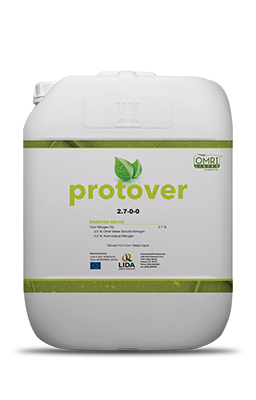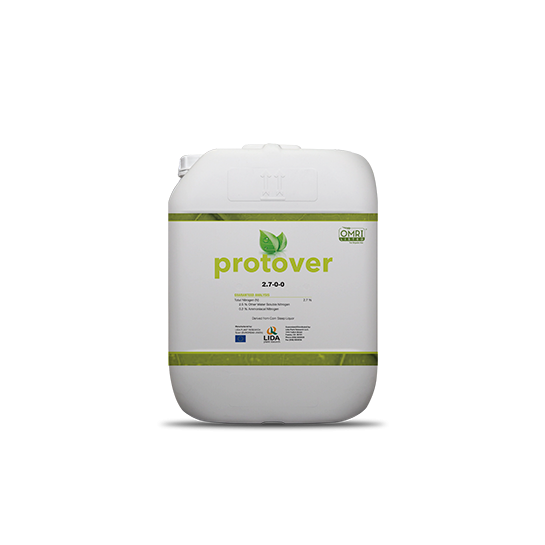

Protover is a nutritional balancer and growth cell bioactivator with fast absorption through both leaves and roots. It also functions as a means of transport for other fertilizers, micronutrients, and plant protection products. The product contains 4.9% free amino acids, 12.5% organic matter, and 2.7% total nitrogen (2.5% water-soluble nitrogen, 0.2% ammoniacal nitrogen), derived from corn protein hydrolysate. It has a density of 9.85 lb/gal (1.18 kg/L) at 68°F and a relative density of 1.16 to 1.18. The product is available in 2.5 gallon (9.46 liter) containers. It is not classified as hazardous under Regulation (EC) No 1272/2008.
Functional Mechanism
Protover acts as a biostimulant and nutrient transport aid. The free amino acids derived from corn protein hydrolysate are absorbed directly through leaf and root tissues, bypassing soil transformation. These amino acids serve as building blocks for protein synthesis, precursors for plant hormones, and chelating agents that enhance the uptake of co-applied nutrients and pesticides. The product functions as a transport mechanism, improving the penetration, absorption, and exchange of other fertilizers and plant protection products applied in mixture. Key claimed effects include: stimulation of plant growth and development; improvement of fruit size, sugar content, color, and brightness; prevention and overcoming of critical stages and adverse situations; enhancement of photosynthetic activity and protein synthesis; and increased production of auxins and enzyme regulators.
Target Applications and Rates
Vegetables (pepper, tomato, melons, cucumber, squash, pumpkin, green beans, green peas, onion, garlic, potato, sweet potato, carrot, beets, cabbage, cauliflower, broccoli, brussel sprouts, radish, leafy greens including lettuce, celery, cilantro, parsley, chards, spinach, asparagus, artichoke)
-
Standard foliar rate: 10 to 24 fl oz per acre
-
Use lower rates if spray volume is less than 30 gal/acre; higher rates if volume exceeds 60 gal/acre
-
Terrestrial application concentration: 3 to 4 fl oz per 10 gallons water
-
Aircraft applications: low to medium rate
-
-
Recovery foliar rate (frost, hail, or phytotoxicity damage): 16 to 32 fl oz per acre
-
Terrestrial application concentration: 5 to 6 fl oz per 10 gallons water
-
Aircraft applications: low to medium rate
-
-
Fertigation rate: 2 to 3 pints per acre. For overhead sprinkler irrigation, use lower rate.
Strawberry, Blackberry, Raspberry, Blueberry
-
Standard foliar rate: 16 to 32 fl oz per acre
-
Use lower rates if spray volume is less than 40 gal/acre; higher rates if volume exceeds 100 gal/acre
-
Terrestrial application concentration: 3 to 4 fl oz per 10 gallons water
-
Aircraft applications: low to medium rate
-
-
Recovery foliar rate (frost, hail, or phytotoxicity damage): 24 to 48 fl oz per acre
-
Terrestrial application concentration: 4 to 6 fl oz per 10 gallons water
-
Aircraft applications: low to medium rate
-
-
Fertigation rate: 2 to 3 pints per acre. For overhead sprinkler irrigation, use lower rate.
Grapes (Wine & Table)
-
Standard foliar rate: 12 to 24 fl oz per acre
-
Use lower rates if spray volume is less than 50 gal/acre; higher rates if volume exceeds 100 gal/acre
-
Terrestrial application concentration: 2 to 2.5 fl oz per 10 gallons water
-
-
Recovery foliar rate (frost, hail, or phytotoxicity damage): 16 to 32 fl oz per acre
-
Terrestrial application concentration: 3 to 4 fl oz per 10 gallons water
-
Aircraft applications: low to medium rate
-
-
Fertigation rate: 2 to 3 pints per acre. Use low to medium rate with drip system; medium to high rate with any sprinkler system.
Fruit and Nut Trees (orange, lemon, lime, mandarin, grapefruit, apple, stone fruits including peach, cherry; nuts including almond, walnut, pecan, pistachio; avocado, fig)
-
Standard foliar rate: 20 to 32 fl oz per acre
-
Avoid application on apricot, plum, and tangelo
-
Use lower rates if spray volume is less than 70 gal/acre; higher rates if volume exceeds 125 gal/acre
-
Terrestrial application concentration: 2 to 3 fl oz per 10 gallons water
-
Aircraft applications: low to medium rate
-
-
Recovery foliar rate (frost, hail, or phytotoxicity damage): 32 to 48 fl oz per acre
-
Terrestrial application concentration: 4 to 5 fl oz per 10 gallons water
-
Aircraft applications: low to medium rate
-
-
Fertigation rate: 2 to 4 pints per acre. Use low to medium rate with drip system; medium to high rate with any sprinkler system.
Row Crops (corn, sorghum, wheat, barley, dry beans, soy beans, cotton)
-
Foliar rate: 8 to 16 fl oz per acre
-
Terrestrial application concentration: 3 to 5 fl oz per 10 gallons water
-
Fertigation rate: 1 to 2 pints per acre. Can be applied with any pressurized irrigation system.
Forage Crops (alfalfa, hay grasses)
-
Foliar rate: 8 to 24 fl oz per acre
-
Terrestrial application concentration: 4 to 6 fl oz per 10 gallons water
-
Fertigation rate: 2 to 4 pints per acre. Can be applied with any pressurized irrigation system.
Nurseries & Landscape (ornamental, trees, turf, sod)
-
Foliar rate: 12 to 32 fl oz per acre
-
Use lower rates if spray volume is less than 30 gal/acre; higher rates if volume exceeds 50 gal/acre
-
Terrestrial application concentration: 4 to 5 fl oz per 10 gallons water
-
-
Fertigation rate: 1 to 2 fl oz per 1,000 square feet. Use low to medium rate with drip system; medium to high rate with any sprinkler system.
Incompatibilities and Restrictions
-
Do not mix with mineral oils, copper salts, or sulfur
-
After a copper salt application, do not apply Protover for 4 to 5 days
-
Do not apply to plum trees, apricot trees, and some varieties of tangelo due to risk of phytotoxicity
-
Prior tests of compatibility and phytotoxicity are recommended with any mixture containing plant protection products or fertilizers
Use Restrictions and Warnings
Use only when necessary. Do not exceed the recommended rate. The user is responsible for any damages caused by lack of efficacy, toxicity, or residues due to failure to follow label instructions. Keep out of reach of children. Keep away from food, drinks, and cattle feed.
Storage and Handling
Avoid low temperatures in winter and temperatures above 82°F (28°C). Avoid direct sunlight and long storage periods. Store between 5°C and 35°C (41°F to 95°F) in a dry, well-ventilated place. Keep away from oxidizing agents and bases. Keep away from sources of heat and direct sunlight. Once opened, containers must be carefully closed and placed vertically to prevent spills. Never use pressure to empty containers; they are not pressure-resistant.
Chemical Stability
The product is unstable in contact with bases. Neutralization can occur on contact with bases. Avoid contact with bases. Hazardous decomposition products may include corrosive vapors or gases.
Safety and First Aid
The product is not classified as hazardous. No individual protection equipment is strictly required, though work footwear is recommended. In the application area, smoking, eating, and drinking must be prohibited.
-
Inhalation: Move victim to open air; keep warm and calm. If breathing is irregular or stops, perform artificial respiration.
-
Eye contact: Remove contact lenses if present. Wash eyes with plenty of clean, cool water for at least 10 minutes while holding eyelids open. Seek medical assistance.
-
Skin contact: Remove contaminated clothing. Wash skin vigorously with water and soap or a suitable skin cleaner. Never use solvents or thinners.
-
Ingestion: Keep calm. Never induce vomiting.
Repeated or prolonged contact may cause the removal of natural oils from the skin, leading to non-allergic contact dermatitis and absorption through the skin. Splashes in the eyes may cause irritation and reversible damage. No known acute or delayed effects from exposure to the product. In case of doubt or when symptoms persist, get medical attention. Never administer anything orally to unconscious persons.
Environmental Precautions
Do not allow product to enter sewers or waterways. Prevent penetration into the ground. Contain and collect spills with non-combustible absorbent materials (earth, sand, vermiculite, diatomite). Clean area immediately with a suitable decontaminant. Dispose of waste according to local and national regulations.
Firefighting Measures
Suitable extinguishing media include powder, CO₂, alcohol-resistant foam, and water spray. Do not use a direct stream of water. In the presence of electrical voltage, do not use water or foam. Fire can produce thick, black smoke; thermal decomposition may form carbon monoxide and carbon dioxide. Use water to cool containers close to heat source or fire.
Compliance
Information regarding the contents and levels of metals in this product is available at http://www.aapfco.org/metals.htm. The product is not affected by the SEVESO III Directive (2012/18/EU).