
Lida Plant Research Lidafol PL - 8-20-11 - Plant Vigor and Crop Productivity Enhancer


About this product
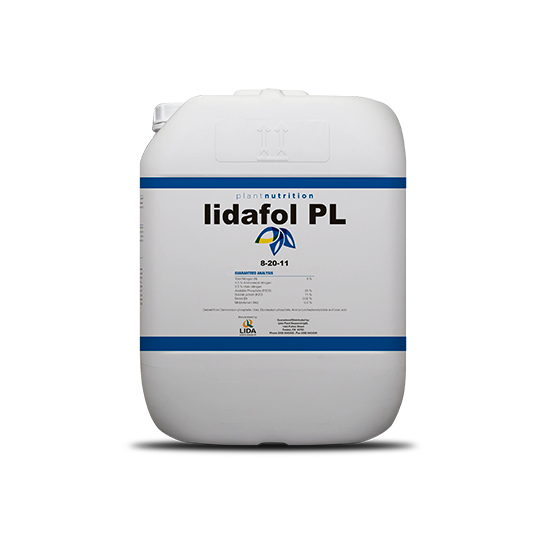
Lidafol PL is a liquid foliar fertilizer formulated specifically for blooming treatments to promote plant vigor and improve flowering quality. It provides a readily available source of nitrogen and phosphorus during the critical reproductive window when floral initiation, pollen development, and ovule fertility determine final fruit set and yield. Unlike balanced or vegetative-stage fertilizers, Lidafol PL employs a high-phosphorus ratio (8-20-11) to support energy transfer, cell division, and flower development. The product contains 8% total nitrogen (4.5% ammoniacal nitrogen, 3.5% ureic nitrogen), 20% available phosphate (P₂O₅), 11% soluble potash (K₂O), 0.02% boron, and 0.3% molybdenum. It is derived from diammonium phosphate, urea, dipotassium phosphate, ammonium heptamolybdate, and boric acid. The product is a dark brown liquid with a density of 11.77 lb/gal (1.41 kg/L) at 68°F, a pH of 8 to 9 at 0.2% dilution, and is available in 2.5 gallon containers with a net weight of 29.4 lbs.
Chemical Composition and Formulation
-
Total Nitrogen (N): 8% (4.5% ammoniacal nitrogen, 3.5% ureic nitrogen)
-
Available Phosphate (P₂O₅): 20%
-
Soluble Potash (K₂O): 11%
-
Boron (B): 0.02%
-
Molybdenum (Mo): 0.3%
Derived from diammonium phosphate, urea, dipotassium phosphate, ammonium heptamolybdate, and boric acid.
The product is not classified as hazardous under Regulation (EC) No 1272/2008, though boric acid is present at 0.1-5.5% concentration and is classified as Repr. 1B, H360FD (may damage fertility and the unborn child) at concentrations of 5.5% or higher.
Functional Mechanism
Phosphorus is the primary driver of flowering and fruiting. During bloom, developing flowers require large quantities of ATP for the energetic demands of floral organ formation, pollen tube growth, and ovule development. Phosphorus deficiency at this stage results in flower abortion, poor fruit set, and reduced yield regardless of subsequent nutrition. Lidafol PL delivers a concentrated 20% phosphate source directly to floral tissues via foliar application, bypassing soil tie-up and root uptake limitations common with granular phosphorus fertilizers. The boron component (0.02%) supports pollen germination and tube elongation; boron deficiency is a known cause of poor fruit set and fruit deformities. Molybdenum (0.3%) is an essential cofactor for nitrate reductase, the enzyme that converts nitrate into amino acids; during rapid flowering, molybdenum availability directly impacts nitrogen assimilation efficiency.
Target Applications and Performance
Citrus
-
Make one foliar application at flowering
-
Make a second application at mid-flower fading (50% fallen petals)
Fruit Trees and Wine Grapes
-
First application: when 5% of first flowers are open
-
Second application: 7 to 10 days later
Vegetables
-
First application: at the beginning of flowering
-
Second application: at full bloom
Rates
-
Application rate: 3 fluid ounces per 10 gallons of water
Water Volume Guidelines
-
Vegetables: 40 to 70 gallons per acre
-
Trees and wine grapes: 50 to 90 gallons per acre
Use Restrictions and Warnings
The use of Lidafol PL on any other crop or at any other timing not listed on the label may result in serious crop injury. The application of fertilizing materials containing molybdenum may result in forage crops containing levels of molybdenum toxic to ruminant animals. Use only when necessary. Do not exceed the recommended rate. The user is responsible for any damages caused by lack of efficacy, toxicity, or residues due to failure to follow label instructions. Keep out of reach of children. Keep away from food, drinks, and cattle feed.
Storage and Handling
Avoid low temperatures in winter and temperatures above 82°F (28°C). Avoid direct sunlight and long storage periods. Store between 5°C and 35°C (41°F to 95°F) in a dry, well-ventilated place. Keep away from oxidizing agents and highly acidic or alkaline materials. Keep away from sources of heat, radiation, and electricity. Avoid contact with food. Once opened, containers must be carefully closed and placed vertically to prevent spills. Never use pressure to empty containers; they are not pressure-resistant.
Safety and First Aid
The product is not classified as hazardous under normal use conditions. No individual protection equipment is required when the product is handled correctly, though work footwear is recommended. In the application area, smoking, eating, and drinking must be prohibited.
-
Inhalation: Move victim to open air; keep warm and calm. If breathing is irregular or stops, perform artificial respiration.
-
Eye contact: Remove contact lenses if present. Wash eyes with plenty of clean, cool water for at least 10 minutes while holding eyelids open. Seek medical assistance.
-
Skin contact: Remove contaminated clothing.
-
Ingestion: Keep calm. Never induce vomiting.
Repeated or prolonged contact with the product may cause the elimination of oil from the skin, leading to non-allergic contact dermatitis and absorption through the skin. Splashes in the eyes may cause irritation and reversible damage. In case of doubt or when symptoms persist, get medical attention. Never administer anything orally to unconscious persons.
Environmental Precautions
Do not allow product to enter sewers or waterways. Prevent penetration into the ground. Contain and collect spills with inert absorbent material (earth, sand, vermiculite, diatomite). Clean area immediately with a suitable decontaminant. Dispose of waste according to local and national regulations.
Firefighting Measures
The product is not classified as flammable. Suitable extinguishing media include powder, CO₂, alcohol-resistant foam, and water spray. Do not use a direct stream of water. In the presence of electrical voltage, do not use water or foam. Fire can produce thick, black smoke; thermal decomposition may form carbon monoxide and carbon dioxide. Use water to cool containers close to heat source or fire. Use protective suits against heat, individual breathing equipment, gloves, protective goggles or facemasks, and boots according to fire size.
Incompatibilities
The product is unstable in contact with acids, bases, and oxidizing agents. Under certain conditions, polymerization may occur. Avoid heating, high temperatures, and contact with incompatible materials. Hazardous decomposition products include carbon oxides and other organic compounds.
Compliance
Information regarding the contents and levels of metals in this product is available at http://www.aapfco.org/metals.html. The product is not affected by the SEVESO III Directive (2012/18/EU). EUH210: Safety data sheet available on request.
-
 NLPR012 Lida Plant Research Lidafol PL - 8-20-11 - Plant Vigor and Crop Productivity Enhancer - 2.5 Gallons
 -
NLPR013 Lida Plant Research Lidafol PL - 8-20-11 - Plant Vigor and Crop Productivity Enhancer - 265 Gallons
Details
Lidafol PL is a liquid foliar fertilizer formulated specifically for blooming treatments to promote plant vigor and improve flowering quality. It provides a readily available source of nitrogen and phosphorus during the critical reproductive window when floral initiation, pollen development, and ovule fertility determine final fruit set and yield. Unlike balanced or vegetative-stage fertilizers, Lidafol PL employs a high-phosphorus ratio (8-20-11) to support energy transfer, cell division, and flower development. The product contains 8% total nitrogen (4.5% ammoniacal nitrogen, 3.5% ureic nitrogen), 20% available phosphate (P₂O₅), 11% soluble potash (K₂O), 0.02% boron, and 0.3% molybdenum. It is derived from diammonium phosphate, urea, dipotassium phosphate, ammonium heptamolybdate, and boric acid. The product is a dark brown liquid with a density of 11.77 lb/gal (1.41 kg/L) at 68°F, a pH of 8 to 9 at 0.2% dilution, and is available in 2.5 gallon containers with a net weight of 29.4 lbs.
Chemical Composition and Formulation
-
Total Nitrogen (N): 8% (4.5% ammoniacal nitrogen, 3.5% ureic nitrogen)
-
Available Phosphate (P₂O₅): 20%
-
Soluble Potash (K₂O): 11%
-
Boron (B): 0.02%
-
Molybdenum (Mo): 0.3%
Derived from diammonium phosphate, urea, dipotassium phosphate, ammonium heptamolybdate, and boric acid.
The product is not classified as hazardous under Regulation (EC) No 1272/2008, though boric acid is present at 0.1-5.5% concentration and is classified as Repr. 1B, H360FD (may damage fertility and the unborn child) at concentrations of 5.5% or higher.
Functional Mechanism
Phosphorus is the primary driver of flowering and fruiting. During bloom, developing flowers require large quantities of ATP for the energetic demands of floral organ formation, pollen tube growth, and ovule development. Phosphorus deficiency at this stage results in flower abortion, poor fruit set, and reduced yield regardless of subsequent nutrition. Lidafol PL delivers a concentrated 20% phosphate source directly to floral tissues via foliar application, bypassing soil tie-up and root uptake limitations common with granular phosphorus fertilizers. The boron component (0.02%) supports pollen germination and tube elongation; boron deficiency is a known cause of poor fruit set and fruit deformities. Molybdenum (0.3%) is an essential cofactor for nitrate reductase, the enzyme that converts nitrate into amino acids; during rapid flowering, molybdenum availability directly impacts nitrogen assimilation efficiency.
Target Applications and Performance
Citrus
-
Make one foliar application at flowering
-
Make a second application at mid-flower fading (50% fallen petals)
Fruit Trees and Wine Grapes
-
First application: when 5% of first flowers are open
-
Second application: 7 to 10 days later
Vegetables
-
First application: at the beginning of flowering
-
Second application: at full bloom
Rates
-
Application rate: 3 fluid ounces per 10 gallons of water
Water Volume Guidelines
-
Vegetables: 40 to 70 gallons per acre
-
Trees and wine grapes: 50 to 90 gallons per acre
Use Restrictions and Warnings
The use of Lidafol PL on any other crop or at any other timing not listed on the label may result in serious crop injury. The application of fertilizing materials containing molybdenum may result in forage crops containing levels of molybdenum toxic to ruminant animals. Use only when necessary. Do not exceed the recommended rate. The user is responsible for any damages caused by lack of efficacy, toxicity, or residues due to failure to follow label instructions. Keep out of reach of children. Keep away from food, drinks, and cattle feed.
Storage and Handling
Avoid low temperatures in winter and temperatures above 82°F (28°C). Avoid direct sunlight and long storage periods. Store between 5°C and 35°C (41°F to 95°F) in a dry, well-ventilated place. Keep away from oxidizing agents and highly acidic or alkaline materials. Keep away from sources of heat, radiation, and electricity. Avoid contact with food. Once opened, containers must be carefully closed and placed vertically to prevent spills. Never use pressure to empty containers; they are not pressure-resistant.
Safety and First Aid
The product is not classified as hazardous under normal use conditions. No individual protection equipment is required when the product is handled correctly, though work footwear is recommended. In the application area, smoking, eating, and drinking must be prohibited.
-
Inhalation: Move victim to open air; keep warm and calm. If breathing is irregular or stops, perform artificial respiration.
-
Eye contact: Remove contact lenses if present. Wash eyes with plenty of clean, cool water for at least 10 minutes while holding eyelids open. Seek medical assistance.
-
Skin contact: Remove contaminated clothing.
-
Ingestion: Keep calm. Never induce vomiting.
Repeated or prolonged contact with the product may cause the elimination of oil from the skin, leading to non-allergic contact dermatitis and absorption through the skin. Splashes in the eyes may cause irritation and reversible damage. In case of doubt or when symptoms persist, get medical attention. Never administer anything orally to unconscious persons.
Environmental Precautions
Do not allow product to enter sewers or waterways. Prevent penetration into the ground. Contain and collect spills with inert absorbent material (earth, sand, vermiculite, diatomite). Clean area immediately with a suitable decontaminant. Dispose of waste according to local and national regulations.
Firefighting Measures
The product is not classified as flammable. Suitable extinguishing media include powder, CO₂, alcohol-resistant foam, and water spray. Do not use a direct stream of water. In the presence of electrical voltage, do not use water or foam. Fire can produce thick, black smoke; thermal decomposition may form carbon monoxide and carbon dioxide. Use water to cool containers close to heat source or fire. Use protective suits against heat, individual breathing equipment, gloves, protective goggles or facemasks, and boots according to fire size.
Incompatibilities
The product is unstable in contact with acids, bases, and oxidizing agents. Under certain conditions, polymerization may occur. Avoid heating, high temperatures, and contact with incompatible materials. Hazardous decomposition products include carbon oxides and other organic compounds.
Compliance
Information regarding the contents and levels of metals in this product is available at http://www.aapfco.org/metals.html. The product is not affected by the SEVESO III Directive (2012/18/EU). EUH210: Safety data sheet available on request.