
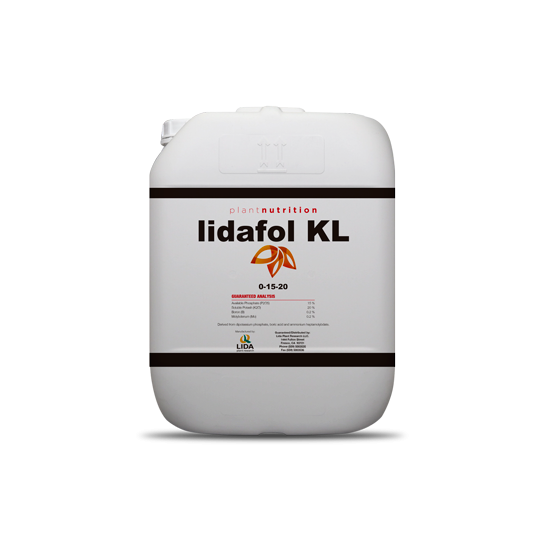
Lida Plant Research Lidafol KL - 0-15-20 - Fruit Growth and Ripening Promoter



About this product
Lidafol KL is a liquid foliar fertilizer formulated specifically for use during the fruit ripening stage. As fruit matures, the demand for potassium increases dramatically to support sugar accumulation, acid regulation, color development, and cell wall consolidation. Potassium activates enzymes involved in starch-to-sugar conversion, anthocyanin synthesis, and phloem loading—all of which determine final fruit quality, flavor, and shelf life. The product provides 0% nitrogen, 15% available phosphate (P₂O₅), and 20% soluble potash (K₂O), with 0.2% boron and 0.2% molybdenum. It is derived from dipotassium phosphate, boric acid, and ammonium heptamolybdate. The product is a dark brown liquid with a density of 12.52 lb/gal (1.5 kg/L) at 68°F, a pH of 8.2 to 9.2, and is available in 1.32 gallon (5 liter) containers with net weight 16.52 lbs and 0.26 gallon (1 liter) containers with net weight 3.30 lbs.
Chemical Composition and Formulation
-
Available Phosphate (P₂O₅): 15%
-
Soluble Potassium (K₂O): 20%
-
Boron (B): 0.2%
-
Molybdenum (Mo): 0.2%
Derived from dipotassium phosphate, boric acid, and ammonium heptamolybdate.
The product contains boric acid at 0.1-5.5% concentration, which is classified as Repr. 1B, H360FD (may damage fertility and the unborn child) at concentrations of 5.5% or higher. The product itself is not classified as hazardous under Regulation (EC) No 1272/2008. EUH statements: EUH210 (Safety data sheet available on request). Restricted to professional users.
Functional Mechanism
Potassium is the dominant cation in developing fruit. During ripening, potassium regulates osmotic potential, driving water movement into fruit for expansion and maintaining turgor. It activates invertase and sucrose synthase, enzymes that convert translocated sucrose into hexoses (glucose and fructose), directly determining sweetness. Potassium also modulates vacuolar pH by counter-transport with protons, affecting organic acid balance—too little potassium results in excessively acidic fruit. In citrus, potassium is directly linked to rind thickness, peel color intensity, and resistance to creasing.
Phosphorus at 15% supports energy transfer during the high-metabolic activity of ripening. Boron at 0.2% is critical for sugar translocation across cell membranes; boron deficiency during fruit development results in poor sugar accumulation, corky tissue, and internal breakdown. Molybdenum at 0.2% supports nitrogen metabolism even in a low-nitrogen formulation, ensuring that amino acid synthesis for flavor compounds proceeds efficiently.
Target Applications and Performance
Citrus: Especially for early varieties and fine lemon, as well as all varieties of orange, mandarin, and clementine.
Vegetables: Indicated for forced crops under plastic, especially watermelon, melon, pepper, tomato, aubergine (eggplant), strawberry, stick bean, artichoke, and potato.
Fruit trees: Nectarine, peach, grape, loquat, apple, plum, and cherry.
Grapes: Table grapes and wine grapes.
Approved crops summary:
-
Citrus: lemon, orange, mandarin, clementine
-
Vegetables: cucurbits (watermelon, melon, cucumber, squash), pepper, tomato, aubergine, strawberry, beans, artichoke, potato
-
Tree fruit: apple, cherry, loquat, nectarine, peach, plum
-
Grapes: table and wine
Application Specifications
Foliar concentration: 0.2% to 0.3% solution
Citrus, fruit trees, and vines:
-
Apply at least 2 treatments, and in exceptional cases 3 treatments
-
Timing: from the start of fruit coloring until final ripening
Vegetables:
-
Apply several treatments throughout the cultivation cycle
-
Interval: every 10 to 12 days
-
Timing: start treating from fruit differentiation
Use Restrictions and Warnings
Lidafol KL is recommended only for use on citrus, vegetables, fruit trees, and grapes as listed. Use on any other crop or at any other timing not listed on the label may result in serious crop injury. Application of fertilizing materials containing molybdenum may result in forage crops containing levels of molybdenum toxic to ruminant animals. Use only when necessary. Do not exceed the recommended rate. The user is responsible for any damages caused by lack of efficacy, toxicity, or residues due to failure to follow label instructions. Keep out of reach of children. Keep away from food, drinks, and cattle feed.
Storage and Handling
Avoid low temperatures in winter and temperatures above 82°F (28°C). Avoid direct light and long storage periods. Store between 5°C and 35°C (41°F to 95°F) in a dry, well-ventilated place. Keep away from oxidizing agents and highly acidic or alkaline materials. Keep away from sources of heat, radiation, and electricity. Avoid contact with food. Once opened, containers must be carefully closed and placed vertically to prevent spills. Never use pressure to empty containers; they are not pressure-resistant.
Safety and First Aid
The product is not classified as hazardous under normal use conditions. No individual protection equipment is required when the product is handled correctly, though work footwear is recommended. In the application area, smoking, eating, and drinking must be prohibited.
-
Inhalation: Move victim to open air; keep warm and calm. If breathing is irregular or stops, perform artificial respiration. Do not administer anything orally. If unconscious, place in a suitable position and seek medical assistance.
-
Eye contact: Remove contact lenses if present. Wash eyes with plenty of clean, cool water for at least 10 minutes while holding eyelids open. Seek medical assistance.
-
Skin contact: Remove contaminated clothing. Wash skin vigorously with water and soap or a suitable skin cleaner. Never use solvents or thinners.
-
Ingestion: If accidentally ingested, seek immediate medical attention. Keep calm. Never induce vomiting.
Repeated or prolonged contact may cause the removal of natural oils from the skin, leading to non-allergic contact dermatitis and absorption through the skin. Splashes in the eyes may cause irritation and reversible damage. No known acute or delayed effects from exposure to the product. In case of doubt or when symptoms persist, get medical attention. Never administer anything orally to unconscious persons.
Environmental Precautions
Do not allow product to enter sewers or waterways. Prevent penetration into the ground. Contain and collect spills with non-combustible absorbent materials (earth, sand, vermiculite, diatomite). Clean area immediately with a suitable decontaminant. Dispose of waste according to local and national regulations.
Firefighting Measures
The product is not classified as flammable. Suitable extinguishing media include powder, CO₂, alcohol-resistant foam, and water spray. Do not use a direct stream of water. In the presence of electrical voltage, do not use water or foam. Fire can produce thick, black smoke; thermal decomposition may form carbon monoxide and carbon dioxide. Use water to cool containers close to heat source or fire. Use protective suits against heat, individual breathing equipment, gloves, protective goggles or facemasks, and boots according to fire size.
Compliance
Information regarding the contents and levels of metals in this product is available at http://www.aspco.org/metals.htm. The product is not affected by the SEVESO III Directive (2012/18/EU). Restricted to professional users.
-
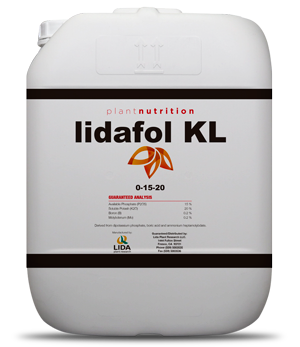 NLPR010 Lida Plant Research Lidafol KL - 0-15-20 - Fruit Growth and Ripening Promoter - 2.5 Gallons
 -
NLPR011 Lida Plant Research Lidafol KL - 0-15-20 - Fruit Growth and Ripening Promoter - 265 Gallons
Details
Lidafol KL is a liquid foliar fertilizer formulated specifically for use during the fruit ripening stage. As fruit matures, the demand for potassium increases dramatically to support sugar accumulation, acid regulation, color development, and cell wall consolidation. Potassium activates enzymes involved in starch-to-sugar conversion, anthocyanin synthesis, and phloem loading—all of which determine final fruit quality, flavor, and shelf life. The product provides 0% nitrogen, 15% available phosphate (P₂O₅), and 20% soluble potash (K₂O), with 0.2% boron and 0.2% molybdenum. It is derived from dipotassium phosphate, boric acid, and ammonium heptamolybdate. The product is a dark brown liquid with a density of 12.52 lb/gal (1.5 kg/L) at 68°F, a pH of 8.2 to 9.2, and is available in 1.32 gallon (5 liter) containers with net weight 16.52 lbs and 0.26 gallon (1 liter) containers with net weight 3.30 lbs.
Chemical Composition and Formulation
-
Available Phosphate (P₂O₅): 15%
-
Soluble Potassium (K₂O): 20%
-
Boron (B): 0.2%
-
Molybdenum (Mo): 0.2%
Derived from dipotassium phosphate, boric acid, and ammonium heptamolybdate.
The product contains boric acid at 0.1-5.5% concentration, which is classified as Repr. 1B, H360FD (may damage fertility and the unborn child) at concentrations of 5.5% or higher. The product itself is not classified as hazardous under Regulation (EC) No 1272/2008. EUH statements: EUH210 (Safety data sheet available on request). Restricted to professional users.
Functional Mechanism
Potassium is the dominant cation in developing fruit. During ripening, potassium regulates osmotic potential, driving water movement into fruit for expansion and maintaining turgor. It activates invertase and sucrose synthase, enzymes that convert translocated sucrose into hexoses (glucose and fructose), directly determining sweetness. Potassium also modulates vacuolar pH by counter-transport with protons, affecting organic acid balance—too little potassium results in excessively acidic fruit. In citrus, potassium is directly linked to rind thickness, peel color intensity, and resistance to creasing.
Phosphorus at 15% supports energy transfer during the high-metabolic activity of ripening. Boron at 0.2% is critical for sugar translocation across cell membranes; boron deficiency during fruit development results in poor sugar accumulation, corky tissue, and internal breakdown. Molybdenum at 0.2% supports nitrogen metabolism even in a low-nitrogen formulation, ensuring that amino acid synthesis for flavor compounds proceeds efficiently.
Target Applications and Performance
Citrus: Especially for early varieties and fine lemon, as well as all varieties of orange, mandarin, and clementine.
Vegetables: Indicated for forced crops under plastic, especially watermelon, melon, pepper, tomato, aubergine (eggplant), strawberry, stick bean, artichoke, and potato.
Fruit trees: Nectarine, peach, grape, loquat, apple, plum, and cherry.
Grapes: Table grapes and wine grapes.
Approved crops summary:
-
Citrus: lemon, orange, mandarin, clementine
-
Vegetables: cucurbits (watermelon, melon, cucumber, squash), pepper, tomato, aubergine, strawberry, beans, artichoke, potato
-
Tree fruit: apple, cherry, loquat, nectarine, peach, plum
-
Grapes: table and wine
Application Specifications
Foliar concentration: 0.2% to 0.3% solution
Citrus, fruit trees, and vines:
-
Apply at least 2 treatments, and in exceptional cases 3 treatments
-
Timing: from the start of fruit coloring until final ripening
Vegetables:
-
Apply several treatments throughout the cultivation cycle
-
Interval: every 10 to 12 days
-
Timing: start treating from fruit differentiation
Use Restrictions and Warnings
Lidafol KL is recommended only for use on citrus, vegetables, fruit trees, and grapes as listed. Use on any other crop or at any other timing not listed on the label may result in serious crop injury. Application of fertilizing materials containing molybdenum may result in forage crops containing levels of molybdenum toxic to ruminant animals. Use only when necessary. Do not exceed the recommended rate. The user is responsible for any damages caused by lack of efficacy, toxicity, or residues due to failure to follow label instructions. Keep out of reach of children. Keep away from food, drinks, and cattle feed.
Storage and Handling
Avoid low temperatures in winter and temperatures above 82°F (28°C). Avoid direct light and long storage periods. Store between 5°C and 35°C (41°F to 95°F) in a dry, well-ventilated place. Keep away from oxidizing agents and highly acidic or alkaline materials. Keep away from sources of heat, radiation, and electricity. Avoid contact with food. Once opened, containers must be carefully closed and placed vertically to prevent spills. Never use pressure to empty containers; they are not pressure-resistant.
Safety and First Aid
The product is not classified as hazardous under normal use conditions. No individual protection equipment is required when the product is handled correctly, though work footwear is recommended. In the application area, smoking, eating, and drinking must be prohibited.
-
Inhalation: Move victim to open air; keep warm and calm. If breathing is irregular or stops, perform artificial respiration. Do not administer anything orally. If unconscious, place in a suitable position and seek medical assistance.
-
Eye contact: Remove contact lenses if present. Wash eyes with plenty of clean, cool water for at least 10 minutes while holding eyelids open. Seek medical assistance.
-
Skin contact: Remove contaminated clothing. Wash skin vigorously with water and soap or a suitable skin cleaner. Never use solvents or thinners.
-
Ingestion: If accidentally ingested, seek immediate medical attention. Keep calm. Never induce vomiting.
Repeated or prolonged contact may cause the removal of natural oils from the skin, leading to non-allergic contact dermatitis and absorption through the skin. Splashes in the eyes may cause irritation and reversible damage. No known acute or delayed effects from exposure to the product. In case of doubt or when symptoms persist, get medical attention. Never administer anything orally to unconscious persons.
Environmental Precautions
Do not allow product to enter sewers or waterways. Prevent penetration into the ground. Contain and collect spills with non-combustible absorbent materials (earth, sand, vermiculite, diatomite). Clean area immediately with a suitable decontaminant. Dispose of waste according to local and national regulations.
Firefighting Measures
The product is not classified as flammable. Suitable extinguishing media include powder, CO₂, alcohol-resistant foam, and water spray. Do not use a direct stream of water. In the presence of electrical voltage, do not use water or foam. Fire can produce thick, black smoke; thermal decomposition may form carbon monoxide and carbon dioxide. Use water to cool containers close to heat source or fire. Use protective suits against heat, individual breathing equipment, gloves, protective goggles or facemasks, and boots according to fire size.
Compliance
Information regarding the contents and levels of metals in this product is available at http://www.aspco.org/metals.htm. The product is not affected by the SEVESO III Directive (2012/18/EU). Restricted to professional users.