
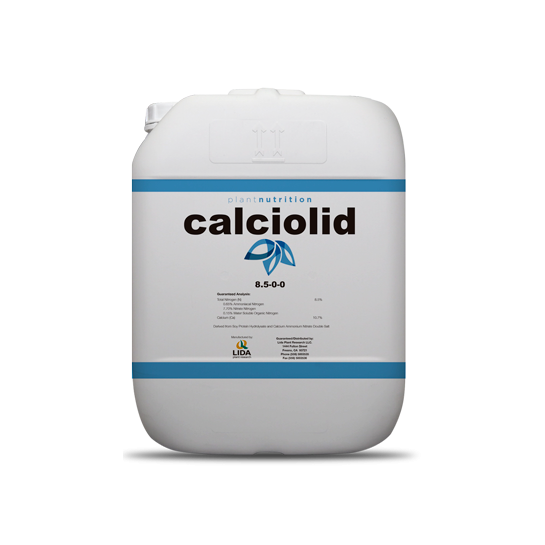
Lida Plant Research CalcioLid - 8.5-0-0 - Calcium-Based Liquid Fertilizer with Protein Hydrolysate



About this product
Calciolid is an aqueous solution of calcium ammonium nitrate and water-soluble organic nitrogen from soy protein hydrolysate, formulated as a soluble concentrate (SC) for foliar spray and soil application. It is a calcium deficiency corrector indicated for treating imbalances in calcium uptake, preventing or reducing fruit cracking, improving fruit conservation conditions by favoring fruit pulp consistency, and preventing blossom end rot, particularly on tomato and pepper. Calcium is an immobile nutrient that moves almost exclusively in the xylem, driven by transpiration. Fruits, which have low transpiration rates relative to leaves, are prone to calcium deficiency even when soil calcium is adequate. Calciolid provides a highly soluble calcium source (calcium ammonium nitrate double salt) combined with amino acids from hydrolyzed soy protein, which may enhance calcium penetration and translocation. The product contains 8.5% total nitrogen (0.65% ammoniacal nitrogen, 7.70% nitrate nitrogen, 0.15% water-soluble organic nitrogen) and 11% calcium (Ca). It is derived from soy protein hydrolysate and calcium ammonium nitrate double salt. The product is a dark brown liquid with a density of 12.52 lb/gal (1.5 kg/L) at 68°F, a pH of 5.5 to 6.5 at 1.1% dilution, and is available in 1.32 gallon (5 liter) containers with net weight 16.53 lbs and 0.26 gallon (1 liter) containers with net weight 3.31 lbs.
Chemical Composition and Formulation
-
Total Nitrogen (N): 8.5%
-
Ammoniacal nitrogen: 0.65%
-
Nitrate nitrogen: 7.70%
-
Water-soluble organic nitrogen: 0.15%
-
-
Calcium (Ca): 11%
Derived from soy protein hydrolysate and calcium ammonium nitrate double salt.
The product contains calcium nitrate (calcium nitrate weight of nitrogen) at 25-75% concentration, classified as Acute Tox. 4, H302 (Harmful if swallowed), Eye Dam. 1, H318 (Causes serious eye damage), and Ox. Sol. 3, H272 (May intensify fire; oxidizer).
Functional Mechanism
Calcium is essential for cell wall structure, membrane integrity, and cell signaling. In developing fruit, calcium deficiency manifests as blossom end rot (tomato, pepper), bitter pit (apple), cracking (cherry, citrus), and internal breakdown. Because calcium moves only in the xylem and is not phloem-mobile, it follows water flow. Fruits, having low transpiration, receive less calcium than leaves even under adequate soil calcium. Calciolid provides calcium in the nitrate form, which is highly soluble and taken up readily. The nitrate anion is cotransported with calcium, enhancing calcium movement. The organic nitrogen fraction from soy protein hydrolysate provides peptides that may chelate calcium, improving cuticular penetration in foliar applications and reducing calcium fixation in soil when applied as a drench.
Target Applications and Performance
Calciolid may be used with all types of crops, including but not limited to:
-
Vegetables: cucumbers, lettuce, spinach, tomato, pepper, potatoes and other tubers, berries
-
Fruit trees: olive, almonds, nectarine, peach, apples, pears, citrus, walnuts
-
Subtropical crops: avocado, mango
-
Trees and vines: almonds, pistachios, walnuts, fishers, pecans
Specific indications:
-
Calcium uptake imbalances
-
Fruit cracking prevention and reduction
-
Improved fruit conservation (favors pulp consistency)
-
Blossom end rot prevention (tomato and pepper)
-
Lettuce: foliar necrosis caused by calcium deficiency; apply from the moment plants have six true leaves
-
Medlar trees: efficient against apical rots
-
Cotton: controls early capsule fall
-
Beet: controls root split (branching)
-
Olive trees: improves setting and avoids or corrects fruit apical rottenness
-
Citrus: especially recommended for skin conservation treatments on sensitive varieties including Fortune, Ellendale, Nova, Hernandine, Navelate
Application Specifications
Drip Irrigation
-
Rate: 1.0 gallon per acre
-
Application: Divide total dose into 2 to 3 applications, with 15 days between each application
Foliar Application
-
Average rate: 1.3 pints per acre
-
Maximum rate (obvious calcium deficiency): up to 2.0 pints per acre
Water Volume Guidelines
-
Floriculture and vegetables: 40 to 70 gallons per acre
-
Trees and vines: 50 to 100 gallons per acre
Application Method
Calciolid can be applied by ground or aircraft.
Use Restrictions and Warnings
Use only when necessary. Do not exceed the recommended rate. The user is responsible for any damages caused by lack of efficacy, toxicity, or residues due to failure to follow label instructions. Keep out of reach of children. Keep away from food, drinks, and cattle feed.
Storage and Handling
Avoid low temperatures in winter and temperatures above 82°F (28°C). Avoid direct light and long storage periods. Store between 5°C and 35°C (41°F to 95°F) in a dry, well-ventilated place, away from sources of heat and direct sunlight. Keep away from oxidizing agents and highly acidic or alkaline materials. Keep away from ignition points. Do not smoke. Once opened, containers must be carefully closed and placed vertically to prevent spills. Never use pressure to empty containers; they are not pressure-resistant.
Safety and Hazard Information
The product is classified as hazardous with signal word Danger. Contains calcium nitrate (25-75%). Hazard statements: H302 (Harmful if swallowed), H318 (Causes serious eye damage), H272 (May intensify fire; oxidizer). Acute toxicity estimate (ATE) for oral exposure: 962 mg/kg.
Personal Protective Equipment (PPE):
-
Breathing protection: Filter mask for gases and particles with A2 filter type
-
Hand protection: PVC chemical-resistant gloves, 0.35 mm thickness, >480 minute breakthrough time
-
Eye protection: Protective goggles with built-in frame
-
Skin protection: Protective clothing and work footwear
Precautionary statements: P264 (Wash thoroughly after handling), P280 (Wear protective gloves/protective clothing/eye protection/face protection), P301+P312 (IF SWALLOWED: Call a POISON CENTER/doctor if you feel unwell), P305+P351+P338 (IF IN EYES: Rinse cautiously with water for several minutes; remove contact lenses if present and easy to do; continue rinsing), P310 (Immediately call a POISON CENTER/doctor), P330 (Rinse mouth), P501 (Dispose of contents/container appropriately).
First Aid Measures
-
Inhalation: Move victim to open air; keep warm and calm. If breathing is irregular or stops, perform artificial respiration. Do not administer anything orally. If unconscious, place in a suitable position and seek medical assistance.
-
Eye contact: Wash eyes with plenty of clean, cool water for at least 10 minutes while holding eyelids open. Seek medical assistance.
-
Skin contact: Remove contaminated clothing. Wash skin vigorously with water and soap or a suitable skin cleaner. Never use solvents or thinners.
-
Ingestion: If accidentally ingested, seek immediate medical attention. Keep calm. Never induce vomiting.
Corrosive product: contact with eyes or skin can cause burns; ingestion or inhalation can cause internal damage. Prolonged inhalation exposure may cause anesthetic effects. Repeated or prolonged contact with the product can cause the elimination of oil from the skin, giving rise to non-allergic contact dermatitis and absorption through the skin. In case of doubt or when symptoms persist, get medical attention. Never administer anything orally to unconscious persons.
Environmental Precautions
Prevent contamination of drains, surface water, groundwater, and soil. Contain and collect spills with non-combustible absorbent materials (earth, sand, vermiculite, diatomite). Clean area immediately with a suitable decontaminant. Dispose of waste according to local and national regulations.
Firefighting Measures
The product is an oxidizer (Ox. Sol. 3). Suitable extinguishing media include powder, CO₂, alcohol-resistant foam, and water spray. Do not use a direct stream of water. In the presence of electrical voltage, do not use water or foam. Fire can produce thick, black smoke; thermal decomposition may form carbon monoxide and carbon dioxide. Use water to cool containers close to heat source or fire. Use protective suits against heat, individual breathing equipment, gloves, protective goggles or facemasks, and boots according to fire size.
Incompatibilities
The product is unstable in contact with bases. Neutralization can occur on contact with bases. Hazardous decomposition products may include corrosive vapors or gases.
Compliance
Information regarding the contents and levels of metals in this product is available at http://www.aaptco.org/metals.htm. The product is not affected by the SEVESO III Directive (2012/18/EU).
-
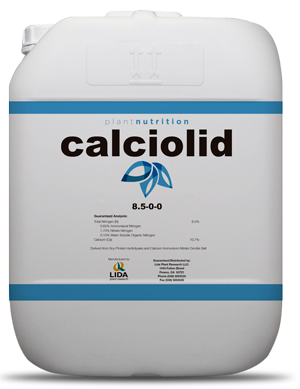 NLPR008 Lida Plant Research CalcioLid - 8.5-0-0 - Calcium-Based Liquid Fertilizer with Protein Hydrolysate - 2.5 Gallons
 -
NLPR009 Lida Plant Research CalcioLid - 8.5-0-0 - Calcium-Based Liquid Fertilizer with Protein Hydrolysate - 265 Gallons
Details
Calciolid is an aqueous solution of calcium ammonium nitrate and water-soluble organic nitrogen from soy protein hydrolysate, formulated as a soluble concentrate (SC) for foliar spray and soil application. It is a calcium deficiency corrector indicated for treating imbalances in calcium uptake, preventing or reducing fruit cracking, improving fruit conservation conditions by favoring fruit pulp consistency, and preventing blossom end rot, particularly on tomato and pepper. Calcium is an immobile nutrient that moves almost exclusively in the xylem, driven by transpiration. Fruits, which have low transpiration rates relative to leaves, are prone to calcium deficiency even when soil calcium is adequate. Calciolid provides a highly soluble calcium source (calcium ammonium nitrate double salt) combined with amino acids from hydrolyzed soy protein, which may enhance calcium penetration and translocation. The product contains 8.5% total nitrogen (0.65% ammoniacal nitrogen, 7.70% nitrate nitrogen, 0.15% water-soluble organic nitrogen) and 11% calcium (Ca). It is derived from soy protein hydrolysate and calcium ammonium nitrate double salt. The product is a dark brown liquid with a density of 12.52 lb/gal (1.5 kg/L) at 68°F, a pH of 5.5 to 6.5 at 1.1% dilution, and is available in 1.32 gallon (5 liter) containers with net weight 16.53 lbs and 0.26 gallon (1 liter) containers with net weight 3.31 lbs.
Chemical Composition and Formulation
-
Total Nitrogen (N): 8.5%
-
Ammoniacal nitrogen: 0.65%
-
Nitrate nitrogen: 7.70%
-
Water-soluble organic nitrogen: 0.15%
-
-
Calcium (Ca): 11%
Derived from soy protein hydrolysate and calcium ammonium nitrate double salt.
The product contains calcium nitrate (calcium nitrate weight of nitrogen) at 25-75% concentration, classified as Acute Tox. 4, H302 (Harmful if swallowed), Eye Dam. 1, H318 (Causes serious eye damage), and Ox. Sol. 3, H272 (May intensify fire; oxidizer).
Functional Mechanism
Calcium is essential for cell wall structure, membrane integrity, and cell signaling. In developing fruit, calcium deficiency manifests as blossom end rot (tomato, pepper), bitter pit (apple), cracking (cherry, citrus), and internal breakdown. Because calcium moves only in the xylem and is not phloem-mobile, it follows water flow. Fruits, having low transpiration, receive less calcium than leaves even under adequate soil calcium. Calciolid provides calcium in the nitrate form, which is highly soluble and taken up readily. The nitrate anion is cotransported with calcium, enhancing calcium movement. The organic nitrogen fraction from soy protein hydrolysate provides peptides that may chelate calcium, improving cuticular penetration in foliar applications and reducing calcium fixation in soil when applied as a drench.
Target Applications and Performance
Calciolid may be used with all types of crops, including but not limited to:
-
Vegetables: cucumbers, lettuce, spinach, tomato, pepper, potatoes and other tubers, berries
-
Fruit trees: olive, almonds, nectarine, peach, apples, pears, citrus, walnuts
-
Subtropical crops: avocado, mango
-
Trees and vines: almonds, pistachios, walnuts, fishers, pecans
Specific indications:
-
Calcium uptake imbalances
-
Fruit cracking prevention and reduction
-
Improved fruit conservation (favors pulp consistency)
-
Blossom end rot prevention (tomato and pepper)
-
Lettuce: foliar necrosis caused by calcium deficiency; apply from the moment plants have six true leaves
-
Medlar trees: efficient against apical rots
-
Cotton: controls early capsule fall
-
Beet: controls root split (branching)
-
Olive trees: improves setting and avoids or corrects fruit apical rottenness
-
Citrus: especially recommended for skin conservation treatments on sensitive varieties including Fortune, Ellendale, Nova, Hernandine, Navelate
Application Specifications
Drip Irrigation
-
Rate: 1.0 gallon per acre
-
Application: Divide total dose into 2 to 3 applications, with 15 days between each application
Foliar Application
-
Average rate: 1.3 pints per acre
-
Maximum rate (obvious calcium deficiency): up to 2.0 pints per acre
Water Volume Guidelines
-
Floriculture and vegetables: 40 to 70 gallons per acre
-
Trees and vines: 50 to 100 gallons per acre
Application Method
Calciolid can be applied by ground or aircraft.
Use Restrictions and Warnings
Use only when necessary. Do not exceed the recommended rate. The user is responsible for any damages caused by lack of efficacy, toxicity, or residues due to failure to follow label instructions. Keep out of reach of children. Keep away from food, drinks, and cattle feed.
Storage and Handling
Avoid low temperatures in winter and temperatures above 82°F (28°C). Avoid direct light and long storage periods. Store between 5°C and 35°C (41°F to 95°F) in a dry, well-ventilated place, away from sources of heat and direct sunlight. Keep away from oxidizing agents and highly acidic or alkaline materials. Keep away from ignition points. Do not smoke. Once opened, containers must be carefully closed and placed vertically to prevent spills. Never use pressure to empty containers; they are not pressure-resistant.
Safety and Hazard Information
The product is classified as hazardous with signal word Danger. Contains calcium nitrate (25-75%). Hazard statements: H302 (Harmful if swallowed), H318 (Causes serious eye damage), H272 (May intensify fire; oxidizer). Acute toxicity estimate (ATE) for oral exposure: 962 mg/kg.
Personal Protective Equipment (PPE):
-
Breathing protection: Filter mask for gases and particles with A2 filter type
-
Hand protection: PVC chemical-resistant gloves, 0.35 mm thickness, >480 minute breakthrough time
-
Eye protection: Protective goggles with built-in frame
-
Skin protection: Protective clothing and work footwear
Precautionary statements: P264 (Wash thoroughly after handling), P280 (Wear protective gloves/protective clothing/eye protection/face protection), P301+P312 (IF SWALLOWED: Call a POISON CENTER/doctor if you feel unwell), P305+P351+P338 (IF IN EYES: Rinse cautiously with water for several minutes; remove contact lenses if present and easy to do; continue rinsing), P310 (Immediately call a POISON CENTER/doctor), P330 (Rinse mouth), P501 (Dispose of contents/container appropriately).
First Aid Measures
-
Inhalation: Move victim to open air; keep warm and calm. If breathing is irregular or stops, perform artificial respiration. Do not administer anything orally. If unconscious, place in a suitable position and seek medical assistance.
-
Eye contact: Wash eyes with plenty of clean, cool water for at least 10 minutes while holding eyelids open. Seek medical assistance.
-
Skin contact: Remove contaminated clothing. Wash skin vigorously with water and soap or a suitable skin cleaner. Never use solvents or thinners.
-
Ingestion: If accidentally ingested, seek immediate medical attention. Keep calm. Never induce vomiting.
Corrosive product: contact with eyes or skin can cause burns; ingestion or inhalation can cause internal damage. Prolonged inhalation exposure may cause anesthetic effects. Repeated or prolonged contact with the product can cause the elimination of oil from the skin, giving rise to non-allergic contact dermatitis and absorption through the skin. In case of doubt or when symptoms persist, get medical attention. Never administer anything orally to unconscious persons.
Environmental Precautions
Prevent contamination of drains, surface water, groundwater, and soil. Contain and collect spills with non-combustible absorbent materials (earth, sand, vermiculite, diatomite). Clean area immediately with a suitable decontaminant. Dispose of waste according to local and national regulations.
Firefighting Measures
The product is an oxidizer (Ox. Sol. 3). Suitable extinguishing media include powder, CO₂, alcohol-resistant foam, and water spray. Do not use a direct stream of water. In the presence of electrical voltage, do not use water or foam. Fire can produce thick, black smoke; thermal decomposition may form carbon monoxide and carbon dioxide. Use water to cool containers close to heat source or fire. Use protective suits against heat, individual breathing equipment, gloves, protective goggles or facemasks, and boots according to fire size.
Incompatibilities
The product is unstable in contact with bases. Neutralization can occur on contact with bases. Hazardous decomposition products may include corrosive vapors or gases.
Compliance
Information regarding the contents and levels of metals in this product is available at http://www.aaptco.org/metals.htm. The product is not affected by the SEVESO III Directive (2012/18/EU).