
Vertical Pressure Storage Tank

Currently, there are no documents available for this product.



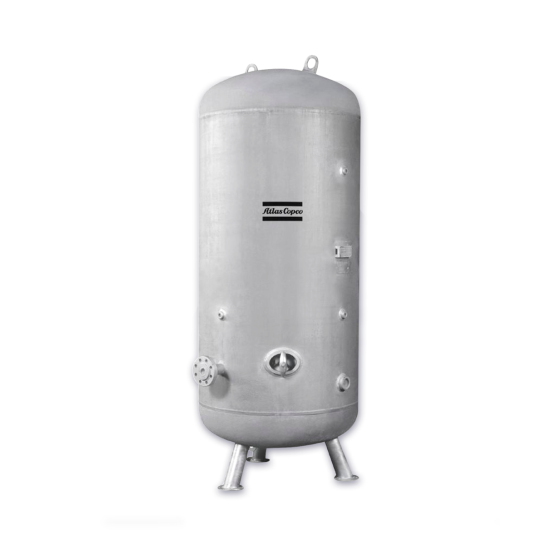
Details
- Safe sizing - HTA receivers easily match a compressor design pressure of 45 bar and a design temperature of 55°C/131°F
- Sturdy construction - Maximum protection thanks to a safe, hot-dip galvanized metallic tank
- Easy installation - Fitted with readily accessible fixation holes for ease of installation
Why do you need an air receiver?
Your air compressor installation can in theory run without a receiver, but not having one in your air system can increase the loading and unloading cycles on the compressor making the compressor work harder. It is important to remember that load/unload cycles will depend on the demand fluctuation within your facility. Air receivers, commonly referred to as vessels or tanks are used to store compressed air before it enters into the piping system and or equipment. In simpler terms, air receivers act as a buffer mechanism between the compressor and the fluctuating pressure caused by the changing demand. Some air compressors can be "tank-mounted", which means that they come as a package and are mounted on top of the air receiver. This type of a set-up is highly preferred at facilities where space comes at a premium. Having a tank mounted compressor can save on both space as well as initial installation costs associated with commissioning a stand-alone dryer. This is most commonly seen with smaller range compressors, mainly up to 26kW or 35 HP. Larger air compressors are not suitable for tank mounted option, as they become top heavy and could pose a safety risk.
How to properly size air receivers?
When it comes to sizing of an air receiver, a good rule of thumb to remember is to allow 3-4 gallons for each CFM or 10-15 liters for each liters/second of compressed air depending on the type of an air compressor used and the application. Similar to sizing of an air compressor, there are a number of factors that should be considered in identifying the right size of air receiver for your installation. It is highly recommended to consider the following factors:
1. Minimizing pressure fluctuations/drops: An air receiver can be used to minimize pressure fluctuations that could have an impact on the production process and the quality of your end product. Selecting the right air tank for your compressor requires you to be mindful of two values: your compressor's output pressure and what your application needs at the point of use. Note that the compressed air stored in your air receiver is only useful as long as its pressure is sufficient for the process which uses it. This is why it is important to consider the duration (in minutes) that the air receiver can supply air at the necessary pressure for your end-user/equipment.
2. Meeting short term peak air demands: If the demand for compressed air changes drastically throughout the day, it is important to account for the spikes in the demand to ensure the system pressure does not drop below an acceptable level. An air receiver provides storage to meet short term peak air demands that the compressor cannot meet. Depending on the time of day, the shift pattern or even unusual demand (e.g. occasional use of a sandblaster or an abrasive media blaster), your air requirement may vary. It is important to fully understand the application and the amount of CFM or liters/second of air required, as well as the expected peaks of your system, as it dictates what flow of compressed air is needed to avoid shortages for any part of your process.
3. Energy considerations: Using an air receiver can help reduce energy consumption of your compressed air system by enabling load/unload (fixed speed) compressors to operate on a longer cycle and with tighter pressure bands. Having properly sized tank and more air than is required will reduce the potential of trim compressor starting up to meet increased flow demand, which can have substantial savings on your energy consumption. This will also prevent pressure fluctuation and frequent motor starts, while providing steady pressure and extending the life of the compressor.
4. Safety considerations: If needed, an air receiver will provide a supply of air to enable production processes and systems to be safely shutdown in an emergency situation.
How often should I drain my air tank?
On compressors without integrated dryers or without a dryer in the system, your air tank may end up with moisture in it. Untreated and wet compressed air can lead to damaged equipment and compromise the quality of your product and it can similarly affect the air receiver as well. Condensation or water will collect in the air receiver and if left undrained, can lead to corrosion, which can threaten the integrity of your air receiver, resulting in early deterioration of the vessel.
It is recommend to draining your air receiver at least once a day and more often if the compressor is running fully loaded throughout the day. An easy way to ensure that you never forget would be to invest in either a float drain, a timer drain or an electronic drain valve.