
CNRG Green Bio-Pesticide Insecticide Miticide Fungicide - Cottonseed Oil 38% - OMRI Certified - 2.5 Gallon (2/Cs) (80/Plt)



About this product
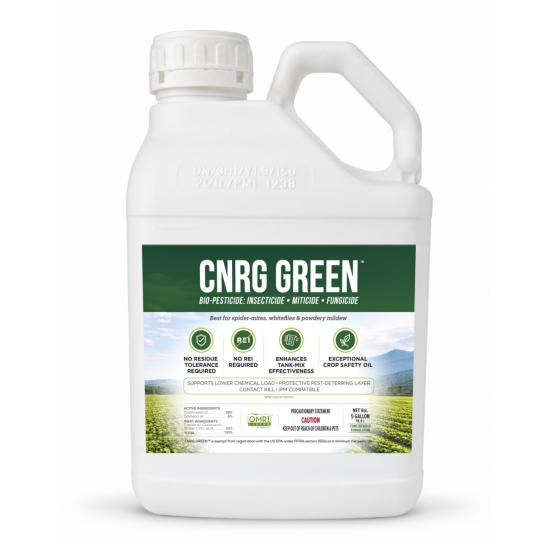
CNRG Green is a broad-spectrum contact insecticide, miticide, and fungicide formulated as a concentrated vegetable oil emulsion using 100% food-grade ingredients. With cottonseed oil (38%) and soybean oil (6%) as active ingredients, it controls spider mites, whiteflies, and powdery mildew, and is OMRI Listed for organic production. Available in a 5-gallon commercial container.
Active Ingredient and Composition
| Component | Percentage |
|---|---|
| Active ingredient: Cottonseed oil | 38% |
| Active ingredient: Soybean oil | 6% |
| Inert ingredients: Canola oil, coconut oil, water, citric acid | 56% |
| Total | 100% |
Concentrated formulation manufactured from food-grade components. Signal word: CAUTION.
Definitions
FIFRA Section 25(b) — a US EPA category for minimum-risk pesticides made from listed ingredients, exempt from full federal registration.
Physical (contact) mode of action — control achieved by physical means such as suffocation and surface coating rather than systemic toxicity, which does not select for chemical resistance.
Functional Mechanism
CNRG Green acts on contact. The oil emulsion coats target pests and blocks the spiracles through which insects and mites respire, killing them by suffocation. On the plant surface it leaves a protective, pest-deterring layer that discourages feeding and colonization, and interferes with the surface establishment of fungal diseases such as powdery mildew. Because the mechanism is physical rather than biochemical, there is no known resistance pathway, making the product well suited to IPM and resistance-management programs. It also enhances tank-mix effectiveness, supporting lower overall chemical load without sacrificing efficacy.
Target Pests and Diseases
Label-listed primary targets: spider mites, whiteflies, and powdery mildew. Effective in tank-mix programs against thrips, pear psyllid, and aphids.
Target Crops
Labeled for use on all food and non-food crops grown in the field or greenhouse, including cucurbits, brassicas, solanaceous crops, berries, leafy vegetables, flowers and ornamentals, and stone fruits. Successfully trialed on tomato, pepper, cucumber, eggplant, zucchini, squash, melon, watermelon, cauliflower, broccoli, cabbage, kale, citrus, pear, avocado, strawberry, raspberry, blackberry, blueberry, herbs and spices, roses, carrot, nectarine, peach, apple, and more. Contact the manufacturer for guidance on additional crops.
Dosing Rate
All listed pests use the same rate structure with a 5-to-10-day application interval.
| Spray Volume (Gallons per Acre) | Product Dosage | Concentration |
|---|---|---|
| 40–80 | 0.8–2.4 gal | 2%–3% |
| 80–120 | 1.2–3 gal | 1.5%–2.5% |
| 120 and up | 1.2–1.8 gal | 1%–1.5% |
Mixing and Application
- Preparation: Shake the container well before dilution and prepare the spray tank with the required amount of water.
- Mixing: Blend in the product at the dosage above and mix until a homogeneous aqueous solution is achieved.
- Spraying: Apply with a high-quality sprayer as a uniform fine mist, ensuring complete coverage of leaves and stems, especially the underside of leaves.
- Timing: Spray in the early morning or at least 3 hours before sunset. Do not spray during high temperatures above 85°F.
Use Restrictions
- Sulfur: Do not mix with sulfur or sulfur-containing products. Ensure spray equipment is free of sulfur residue before use. Do not apply sulfur within 10 days of an oil application, and do not apply oil within 14 days of a sulfur application.
- Incompatible chemistries: Do not use with Captan, Folpet, chlorothalonil (Bravo), dicloran (Botran), permethrin (Ambush, Pounce), dicofol (Kelthane), or propargite (Omite) within 14–30 days before or after use. Do not use chlorothalonil or dicofol in spray programs with this product on grapes, ornamentals, or berries.
- Tank mixing: Do not add other products to the finished formulation unless specifically recommended by the manufacturer.
Crop Safety
An exceptional crop-safety oil that is non-phytotoxic and leaves no significant odor when applied according to label directions. Observe temperature limits and conduct a compatibility and phytotoxicity test on each new crop or variety before full-scale application.
Storage and Disposal
- Store in a cool location out of direct sunlight. Do not store below 35°F.
- Use within 2 months after opening. Use any diluted solution within 24 hours of preparation.
- Follow local and state regulations for non-hazardous material disposal.
Handling and Safety
- PPE: Applicators and handlers must wear a long-sleeved shirt, long pants, shoes, socks, protective eyewear, and gloves.
- Precautions: Do not ingest; avoid contact with skin, eyes, or clothing; wash hands thoroughly with soap and water after handling. Keep out of reach of children and pets.
- First aid: For eye contact, rinse with water; for skin irritation, wash with soap and water; if swallowed, do not induce vomiting and seek immediate medical attention. Refer to the product SDS for further information.
Compliance
Exempt from US EPA registration as a minimum-risk pesticide under FIFRA Section 25(b). OMRI Listed for organic production. No residue tolerance required and no restricted-entry interval required when used as directed.
-
 PAGS010 CNRG Green Bio-Pesticide Insecticide Miticide Fungicide - Cottonseed Oil 38% - OMRI Certified - 2.5 Gallon (2/Cs) (80/Plt)
Details
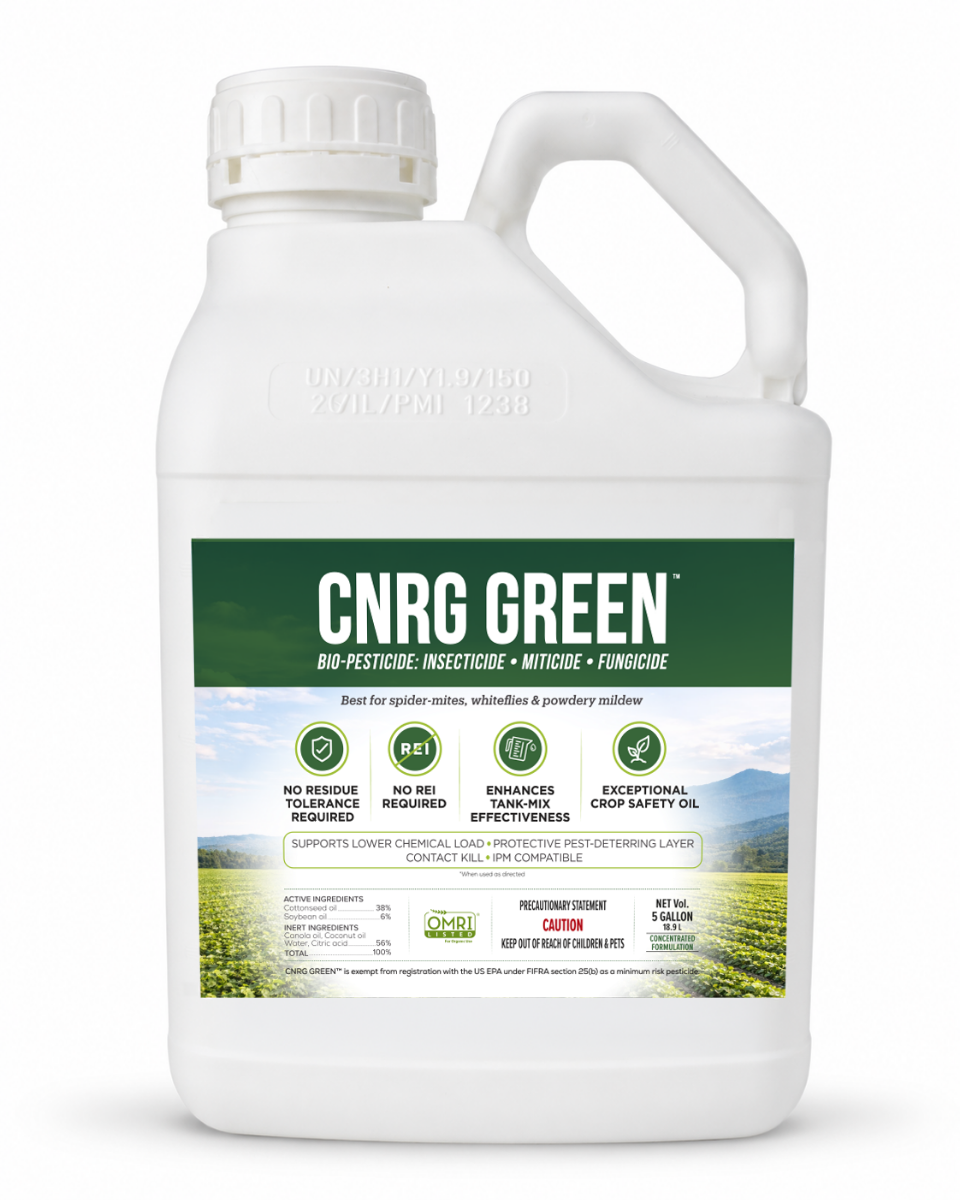
CNRG Green is a broad-spectrum contact insecticide, miticide, and fungicide formulated as a concentrated vegetable oil emulsion using 100% food-grade ingredients. With cottonseed oil (38%) and soybean oil (6%) as active ingredients, it controls spider mites, whiteflies, and powdery mildew, and is OMRI Listed for organic production. Available in a 5-gallon commercial container.
Active Ingredient and Composition
| Component | Percentage |
|---|---|
| Active ingredient: Cottonseed oil | 38% |
| Active ingredient: Soybean oil | 6% |
| Inert ingredients: Canola oil, coconut oil, water, citric acid | 56% |
| Total | 100% |
Concentrated formulation manufactured from food-grade components. Signal word: CAUTION.
Definitions
FIFRA Section 25(b) — a US EPA category for minimum-risk pesticides made from listed ingredients, exempt from full federal registration.
Physical (contact) mode of action — control achieved by physical means such as suffocation and surface coating rather than systemic toxicity, which does not select for chemical resistance.
Functional Mechanism
CNRG Green acts on contact. The oil emulsion coats target pests and blocks the spiracles through which insects and mites respire, killing them by suffocation. On the plant surface it leaves a protective, pest-deterring layer that discourages feeding and colonization, and interferes with the surface establishment of fungal diseases such as powdery mildew. Because the mechanism is physical rather than biochemical, there is no known resistance pathway, making the product well suited to IPM and resistance-management programs. It also enhances tank-mix effectiveness, supporting lower overall chemical load without sacrificing efficacy.
Target Pests and Diseases
Label-listed primary targets: spider mites, whiteflies, and powdery mildew. Effective in tank-mix programs against thrips, pear psyllid, and aphids.
Target Crops
Labeled for use on all food and non-food crops grown in the field or greenhouse, including cucurbits, brassicas, solanaceous crops, berries, leafy vegetables, flowers and ornamentals, and stone fruits. Successfully trialed on tomato, pepper, cucumber, eggplant, zucchini, squash, melon, watermelon, cauliflower, broccoli, cabbage, kale, citrus, pear, avocado, strawberry, raspberry, blackberry, blueberry, herbs and spices, roses, carrot, nectarine, peach, apple, and more. Contact the manufacturer for guidance on additional crops.
Dosing Rate
All listed pests use the same rate structure with a 5-to-10-day application interval.
| Spray Volume (Gallons per Acre) | Product Dosage | Concentration |
|---|---|---|
| 40–80 | 0.8–2.4 gal | 2%–3% |
| 80–120 | 1.2–3 gal | 1.5%–2.5% |
| 120 and up | 1.2–1.8 gal | 1%–1.5% |
Mixing and Application
- Preparation: Shake the container well before dilution and prepare the spray tank with the required amount of water.
- Mixing: Blend in the product at the dosage above and mix until a homogeneous aqueous solution is achieved.
- Spraying: Apply with a high-quality sprayer as a uniform fine mist, ensuring complete coverage of leaves and stems, especially the underside of leaves.
- Timing: Spray in the early morning or at least 3 hours before sunset. Do not spray during high temperatures above 85°F.
Use Restrictions
- Sulfur: Do not mix with sulfur or sulfur-containing products. Ensure spray equipment is free of sulfur residue before use. Do not apply sulfur within 10 days of an oil application, and do not apply oil within 14 days of a sulfur application.
- Incompatible chemistries: Do not use with Captan, Folpet, chlorothalonil (Bravo), dicloran (Botran), permethrin (Ambush, Pounce), dicofol (Kelthane), or propargite (Omite) within 14–30 days before or after use. Do not use chlorothalonil or dicofol in spray programs with this product on grapes, ornamentals, or berries.
- Tank mixing: Do not add other products to the finished formulation unless specifically recommended by the manufacturer.
Crop Safety
An exceptional crop-safety oil that is non-phytotoxic and leaves no significant odor when applied according to label directions. Observe temperature limits and conduct a compatibility and phytotoxicity test on each new crop or variety before full-scale application.
Storage and Disposal
- Store in a cool location out of direct sunlight. Do not store below 35°F.
- Use within 2 months after opening. Use any diluted solution within 24 hours of preparation.
- Follow local and state regulations for non-hazardous material disposal.
Handling and Safety
- PPE: Applicators and handlers must wear a long-sleeved shirt, long pants, shoes, socks, protective eyewear, and gloves.
- Precautions: Do not ingest; avoid contact with skin, eyes, or clothing; wash hands thoroughly with soap and water after handling. Keep out of reach of children and pets.
- First aid: For eye contact, rinse with water; for skin irritation, wash with soap and water; if swallowed, do not induce vomiting and seek immediate medical attention. Refer to the product SDS for further information.
Compliance
Exempt from US EPA registration as a minimum-risk pesticide under FIFRA Section 25(b). OMRI Listed for organic production. No residue tolerance required and no restricted-entry interval required when used as directed.