
Brandt No Foam Spray Adjuvants



About this product
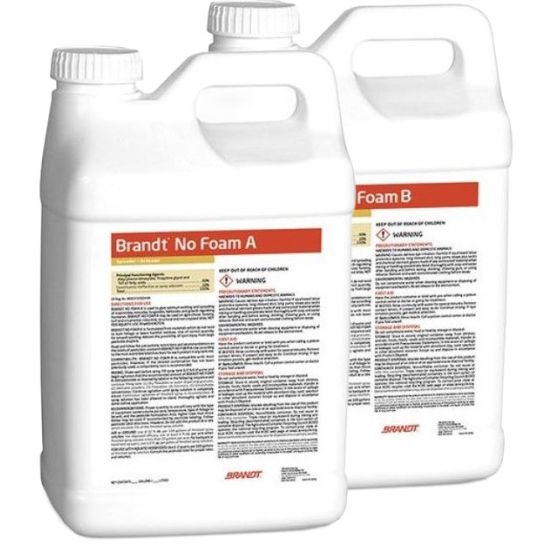
Brandt No Foam A
Product Type & Function
-
A spreader & activator designed to promote optimum wetting and spreading of insecticides, miticides, fungicides, herbicides, and growth-regulating hormones.
-
Suitable for application on agricultural, forestry, turf and ornamental, industrial, structural, and non-cropland sites.
Formulation
-
Principal Functioning Agents (90%): Alkyl phenol ethoxylate, propylene glycol, and tall oil fatty acids.
-
Other constituents (10%) are ineffective as spray adjuvants.
-
Total composition: 100%
-
Formulated from materials that do not tend to burn foliage or leave harmful residues. This helps reduce the risk of spot injury due to large pesticide droplets.
Application Instructions & Rates
-
Always read and follow the label directions of the pesticides used. Apply according to the most restrictive label in any tank mix.
-
Compatibility: Compatible with most pesticides; however, if a combination hasn’t been tried before, conduct a compatibility test.
-
Mixing Sequence:
-
Shake well before use.
-
Fill spray tank halfway with water and begin agitation.
-
Add No Foam A.
-
Then add, in order: Dry flowables/granules → Wettable powders → Flowables → Solutions → Emulsifiable concentrates.
-
Continue agitation throughout mixing and application. If solution stands, re-agitate before use.
-
-
Recommended Rates:
-
Air or Ground: 4–32 fl oz per 100 gallons of finished spray. Use at least 4 fl oz/acre when finished spray volume is under 20 gallons/acre.
-
Backpack or hand-held sprayers: ½ fl oz per gallon of spray solution.
-
Aquatic herbicide applications: 1–2 quarts per 100 gallons of spray solution. Consult herbicide label.
-
-
Do not exceed 5% of the finished spray volume.
Safety & Precautions
-
Hazards:
-
Causes serious eye irritation.
-
Harmful if swallowed.
-
-
Protective measures: Wear protective eyewear, long-sleeved shirt, long pants, shoes plus socks, and chemical-resistant gloves. Wash thoroughly after handling, and remove and wash contaminated clothing before reuse.
-
Environmental: Avoid contaminating water when cleaning equipment or disposing of wash waters.
Storage & Disposal
-
Storage: Store in the original, closed container away from children, animals, foods, feeds, seeds, and incompatible materials. Handle per precautionary statements.
-
Spill response: For spills, absorb with clay, sand, sawdust, or similar absorbent, then dispose per product disposal instructions.
-
Waste disposal: Dispose of wastes on-site or at approved facilities.
-
Container disposal: Nonrefillable container. Triple rinse or equivalent during mixing/loading. Recycle if possible (ACRC), or dispose in a sanitary landfill.
Warranty
-
Seller warrants product conforms to its chemical description and is fit for stated purpose when used as directed. No other warranties (express or implied). Buyer assumes all risks from any such use.
Brandt No Foam B
Product Type & Function
-
A spreader, activator, and buffer—an APE-free, non-ionic surfactant blend—designed to improve the efficiency of fungicide, herbicide, and insecticide applications through better wetting and uniform coverage. It also offers acidifying and buffering properties, aiding spray solutions sensitive to alkaline hydrolysis.
-
Applicable on agricultural, forestry, turf and ornamental, industrial, structural, and non-cropland sites.
Formulation
-
Principal Functioning Agents (25%): Alcohol alkoxylate, benzenesulfonic acid, isopropyl alcohol.
-
The remaining 75% are constituents ineffective as spray adjuvants.
-
Another specimen label provides a more detailed formula: 25% combined anionic–nonionic surfactant blend comprising octyl phenoxy polyethoxy ethanol, isopropanol, linear alkyl sulfonate, buffering acids, coconut amine condensate, silicone defoamer; 75% inert. Suitable for terrestrial and aquatic sites.
Application Instructions & Rates
-
Compatibility: Compatible with most pesticides; if not previously used, conduct a compatibility test.
-
Mixing sequence: Same as No Foam A—shake, half-fill tank, add No Foam B, then add pesticides in recommended order, maintaining agitation throughout.
-
Recommended Rates:
-
Do not exceed 5% of the finished spray volume.
-
Air or Ground sprays: ½–3 pints per 100 gallons of spray solution. Use at least ½ pint per acre when spray volume is under 20 gallons/acre. For backpack or handheld sprayers: 1 fl oz per gallon of spray solution.
-
Alternate rates (specimen): For dilute full-volume sprays:
-
Acaricides, fungicides, insecticides: 4 oz to 1½ pints per 100 gallons.
-
Herbicides, defoliants, desiccants: 8 oz to 3 pints per 100 gallons.
-
-
Safety & Precautions
-
Hazard statements: Causes serious eye irritation; handle with care and wear appropriate protective equipment (e.g., eyewear, gloves, long sleeves, etc.).
-
Environmental: Avoid contaminating water with clean-up water or disposal.
Storage & Disposal
-
Similar to No Foam A: store in the closed, original container; in event of spillage, absorb and dispose; triple rinse containers; recycle or dispose per label instructions.
Additional Notes
-
Biodegradable and formulated to assure quick wetting and uniform coverage.
-
Helps buffer highly alkaline water and enhances performance in agricultural sprays.
Details
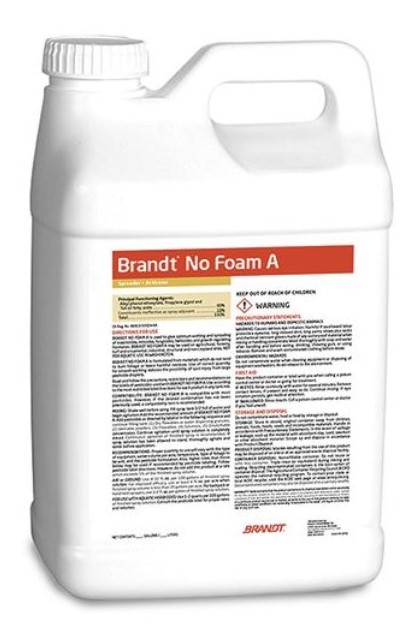
Brandt No Foam A
Product Type & Function
-
A spreader & activator designed to promote optimum wetting and spreading of insecticides, miticides, fungicides, herbicides, and growth-regulating hormones.
-
Suitable for application on agricultural, forestry, turf and ornamental, industrial, structural, and non-cropland sites.
Formulation
-
Principal Functioning Agents (90%): Alkyl phenol ethoxylate, propylene glycol, and tall oil fatty acids.
-
Other constituents (10%) are ineffective as spray adjuvants.
-
Total composition: 100%
-
Formulated from materials that do not tend to burn foliage or leave harmful residues. This helps reduce the risk of spot injury due to large pesticide droplets.
Application Instructions & Rates
-
Always read and follow the label directions of the pesticides used. Apply according to the most restrictive label in any tank mix.
-
Compatibility: Compatible with most pesticides; however, if a combination hasn’t been tried before, conduct a compatibility test.
-
Mixing Sequence:
-
Shake well before use.
-
Fill spray tank halfway with water and begin agitation.
-
Add No Foam A.
-
Then add, in order: Dry flowables/granules → Wettable powders → Flowables → Solutions → Emulsifiable concentrates.
-
Continue agitation throughout mixing and application. If solution stands, re-agitate before use.
-
-
Recommended Rates:
-
Air or Ground: 4–32 fl oz per 100 gallons of finished spray. Use at least 4 fl oz/acre when finished spray volume is under 20 gallons/acre.
-
Backpack or hand-held sprayers: ½ fl oz per gallon of spray solution.
-
Aquatic herbicide applications: 1–2 quarts per 100 gallons of spray solution. Consult herbicide label.
-
-
Do not exceed 5% of the finished spray volume.
Safety & Precautions
-
Hazards:
-
Causes serious eye irritation.
-
Harmful if swallowed.
-
-
Protective measures: Wear protective eyewear, long-sleeved shirt, long pants, shoes plus socks, and chemical-resistant gloves. Wash thoroughly after handling, and remove and wash contaminated clothing before reuse.
-
Environmental: Avoid contaminating water when cleaning equipment or disposing of wash waters.
Storage & Disposal
-
Storage: Store in the original, closed container away from children, animals, foods, feeds, seeds, and incompatible materials. Handle per precautionary statements.
-
Spill response: For spills, absorb with clay, sand, sawdust, or similar absorbent, then dispose per product disposal instructions.
-
Waste disposal: Dispose of wastes on-site or at approved facilities.
-
Container disposal: Nonrefillable container. Triple rinse or equivalent during mixing/loading. Recycle if possible (ACRC), or dispose in a sanitary landfill.
Warranty
-
Seller warrants product conforms to its chemical description and is fit for stated purpose when used as directed. No other warranties (express or implied). Buyer assumes all risks from any such use.
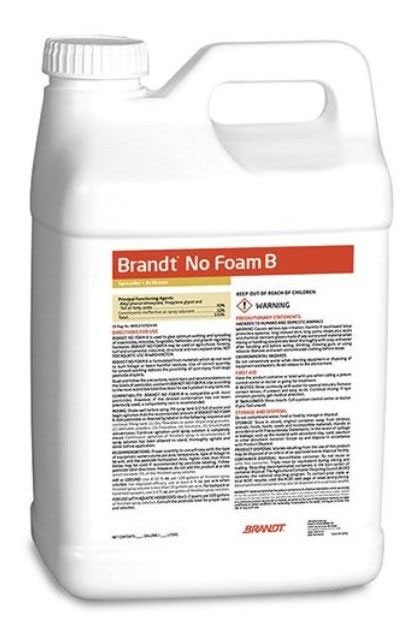
Brandt No Foam B
Product Type & Function
-
A spreader, activator, and buffer—an APE-free, non-ionic surfactant blend—designed to improve the efficiency of fungicide, herbicide, and insecticide applications through better wetting and uniform coverage. It also offers acidifying and buffering properties, aiding spray solutions sensitive to alkaline hydrolysis.
-
Applicable on agricultural, forestry, turf and ornamental, industrial, structural, and non-cropland sites.
Formulation
-
Principal Functioning Agents (25%): Alcohol alkoxylate, benzenesulfonic acid, isopropyl alcohol.
-
The remaining 75% are constituents ineffective as spray adjuvants.
-
Another specimen label provides a more detailed formula: 25% combined anionic–nonionic surfactant blend comprising octyl phenoxy polyethoxy ethanol, isopropanol, linear alkyl sulfonate, buffering acids, coconut amine condensate, silicone defoamer; 75% inert. Suitable for terrestrial and aquatic sites.
Application Instructions & Rates
-
Compatibility: Compatible with most pesticides; if not previously used, conduct a compatibility test.
-
Mixing sequence: Same as No Foam A—shake, half-fill tank, add No Foam B, then add pesticides in recommended order, maintaining agitation throughout.
-
Recommended Rates:
-
Do not exceed 5% of the finished spray volume.
-
Air or Ground sprays: ½–3 pints per 100 gallons of spray solution. Use at least ½ pint per acre when spray volume is under 20 gallons/acre. For backpack or handheld sprayers: 1 fl oz per gallon of spray solution.
-
Alternate rates (specimen): For dilute full-volume sprays:
-
Acaricides, fungicides, insecticides: 4 oz to 1½ pints per 100 gallons.
-
Herbicides, defoliants, desiccants: 8 oz to 3 pints per 100 gallons.
-
-
Safety & Precautions
-
Hazard statements: Causes serious eye irritation; handle with care and wear appropriate protective equipment (e.g., eyewear, gloves, long sleeves, etc.).
-
Environmental: Avoid contaminating water with clean-up water or disposal.
Storage & Disposal
-
Similar to No Foam A: store in the closed, original container; in event of spillage, absorb and dispose; triple rinse containers; recycle or dispose per label instructions.
Additional Notes
-
Biodegradable and formulated to assure quick wetting and uniform coverage.
-
Helps buffer highly alkaline water and enhances performance in agricultural sprays.