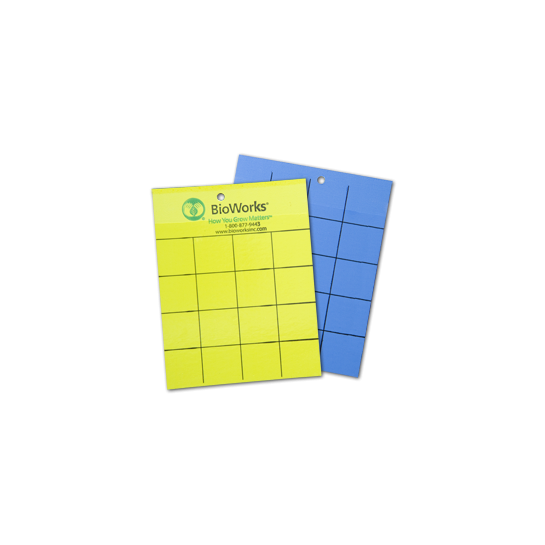
BioWorks 2-Sided Sticky Cards are a dual-color insect monitoring tool designed for professional scouting within Integrated Pest Management (IPM) programs in greenhouse and controlled agricultural environments. This passive, non-toxic device functions as an early detection and population tracking system for key flying insect pests, providing actionable data to inform treatment thresholds and evaluate control efficacy.
Technical Construction and Format
The product consists of a rigid plastic card measuring 4 inches by 5 inches (approximately 100mm x 125mm). Each card is coated on both sides with a weather-resistant adhesive that is ultraviolet light-stable to prevent rapid degradation. The card features a unique double-sided format: one side is yellow and the opposite side is blue. Both surfaces are printed with a 1-inch square grid to facilitate standardized insect counting and population density estimation. Each card is pre-punched with a hole for hanging and is supplied with an easy peel-off backing for simple deployment.
Mode of Action and Pest Specificity
The cards operate on the principle of phototaxis, exploiting the specific color wavelength attractions of target insect pests. The contrasting colors serve as discrete attractants for different pest complexes.
-
The yellow side is primarily attractive to flying adult aphids, whiteflies, fungus gnats, and leafminers.
-
The blue side is specifically tuned to attract flying adult thrips.
This dual-color design allows for targeted monitoring of multiple pest species with a single deployment point. The adhesive surface physically traps insects that land on the card, providing a visual record of pest presence, identity, and relative abundance.
Target Pests
The primary target pests for this monitoring system are:
-
Flying adult aphids
-
Whiteflies
-
Fungus gnats
-
Leafminers
-
Flying adult thrips
Application Specifications and Protocol
Placement and Density: Cards should be hung vertically just above the plant canopy in areas of typical pest activity or near entry points. General guidelines for use in tunnel houses or greenhouses suggest one card per 250 square meters. Density should be increased in high-risk areas or for high-value crops.
Monitoring Protocol: Cards should be checked at regular, defined intervals (e.g., weekly). Pest counts should be recorded using the printed grid system for consistency. Some standardized scouting protocols involve counting insects within a specific subset of grid squares to expedite the process. Data on pest species and counts over time form the basis for deciding if and when a control intervention is necessary.
Replacement: Cards should be replaced when the adhesive surface becomes covered with insects, dust, or debris, or loses its tackiness.
Efficacy and Performance Data
As a monitoring tool, efficacy is measured by the reliable attraction and capture of target pests to provide an accurate representation of population dynamics. The use of scientifically proven color wavelengths ensures optimal attraction rates for the target species. The quantitative data gathered is used to track pest pressure trends, identify hot spots, and verify the success of biological or chemical control applications within the IPM program.
Regulatory and Safety Profile
-
EPA Status: As a monitoring device, it is typically exempt from pesticide registration requirements.
-
Toxicity: The product is non-toxic.
-
Safety Profile: The adhesive is formulated to adhere more strongly to the card and insects than to human skin or clothing fibers, but care should be taken during handling. No personal protective equipment is required for deployment or monitoring.
Storage and Handling
Store unopened cards in a cool, dry place away from direct sunlight and dust to preserve the adhesive properties. The cards are lightweight and have an indefinite shelf life when stored under recommended conditions.
Available Formulations
The product is available in two standard commercial pack sizes: